The healing, centering, powerful magic of Lake Superior is a foundation of strength—and a source of whimsical play, joy and fun for those who live and love here. Whether you’re a child, a child-at-heart or an adult who’s lost touch with your child-at-heart: Superior and the U.P. will speak wisdom to those who listen.
Photographer Keith Glendon is a devoted husband and father of four, poet, writer, joy-seeker, entrepreneur, founder of Campfire CoWorks in Marquette, believer in Spirit and optimistic advocate of a better world.
Excerpted with permission from the Summer 2021 issue of Health & Happiness U.P. Magazine. Copyright 2021, Empowering Lightworks, LLC. All rights reserved.
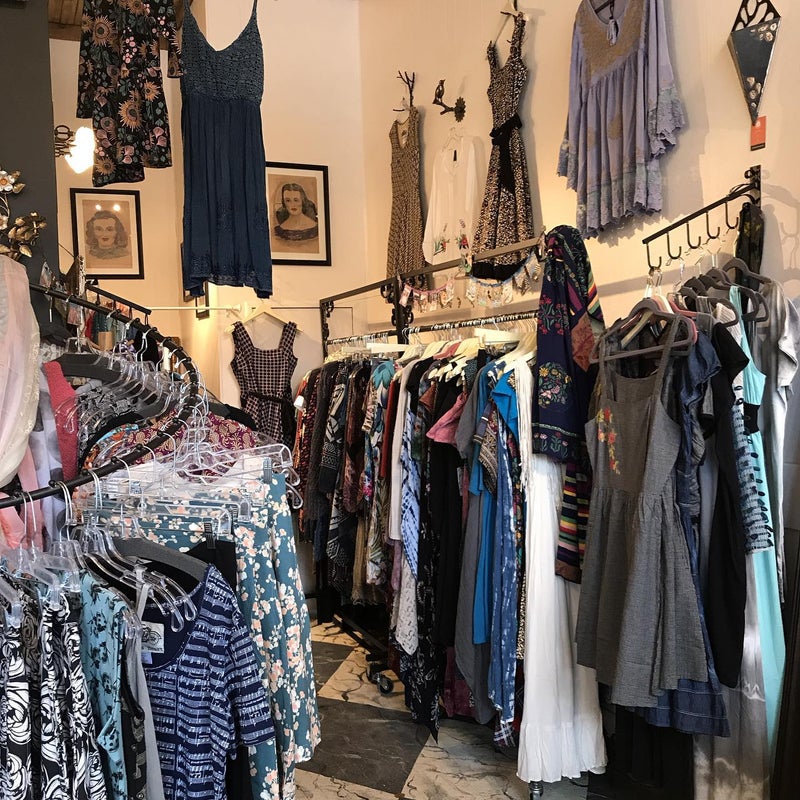
Blackbird carries anything from new vintage-inspired clothing to bohemian to more timeless, elegant classic pieces. I try to have quite a range in a small space, and for a range of ages too.
I spend a lot of time researching and networking with other designers and going to markets to find sustainable, ethical, fair trade clothing and accessories. I think it’s important to understand where your clothes come from and who made them. We carry a lot of things made from natural fibers. They’re more durable, and require less water to manufacture. A couple of brands I carry are zero waste. They use scrap materials that larger clothing manufacturers would have to get rid of, even whole bolts if there’s one little flaw, because they use machines. These are handmade, and if the fabric pieces are too small, they’ll use a more traditional patchwork style or weaving. Some lines use organic cotton or non-toxic, natural dyes. Some manufacturers say their items are natural but they still use copper and things to bring out more vibrant colors in clothing.
There’s a huge selection of locally made jewelry and artwork, gift items, accessories too, a little home décor as well—the little unexpected treasures that people find, whether it’s for themselves or gifts—little luxuries, little out-of-the-ordinary bits ’n bobs. I’m constantly on the hunt for unique jewelry, clothing, and accessories.
While it is difficult at times to be the sole proprietress of a business, it also has many rewards. Blackbird is really an extension of my life, philosophies and interests. It is challenging to have to wear so many hats—to be the creative force, as well as have the business mind that goes with it.
I think Blackbird fits well into the downtown Marquette scene. I feel I’ve created an inviting space and sometimes customers will just pop in for a little inspiration and because they love the way the shop makes them feel. I really can’t believe it’s been four years since Blackbird opened. I am excited to be a part of such a wonderful community here in downtown Marquette.
Why did you open Blackbird?
I grew up with my mom having a boutique. I worked there summers early on during college, and I absolutely loved it—helping women find things that inspired them, and all the patterns and textures and colors of the fabrics. I enjoyed it so much, I was kind of hooked.
Even back then, opening something like Blackbird was always in the back of my mind. I wanted to do it so badly, and just always thought, “It’s not a practical thing. I can’t.” I was afraid of going for it.
I finished school, was living in Denver a while, working at the Clyfford Still Museum. Although I loved it there doing event planning and coordinating for donors or for weddings, I just had this calling. I wanted to do something that made more of an impact. And I was missing Michigan, the lake, and family. It was time to move back. So I decided to go for it.
At the time there wasn’t a lot in Marquette like what I had in mind. I was nervous not knowing what the reaction would be. I always wanted to do something that was good, that made a difference. Finding sustainable, fair trade, ethically-made clothing allows me to offer something good for people and the planet.
I went to Western Michigan University and Kendall College of Art & Design. I have a degree in English, and minors in Environmental Studies and Art History. My education and art background play a big role in the design of Blackbird as well the merchandise I carry. I try to bring in a sort of ethereal, otherworldly vibe, and to make women feel empowered by dressing in a way that respects their confidence. There are things you can’t really find anywhere else—unique pieces that are also timeless and versatile, and can be worn comfortably too, with interesting forms and natural fibers. They just feel better.
What’s new at Blackbird?
I just did a little update while we were closed for March. I took down a couple free-standing walls to open the space up a little bit more. Also, there is a new wall mural, some new lighting, and I’m adding a much needed second dressing room. The space definitely feels more open because of the changes made.
What do you find most challenging about running Blackbird?
So far, the pandemic has been the most challenging thing to go through, but I have managed to successfully stay on top of it by following health department guidelines and offering contactless payments and pick-ups, if people wish. Also, there is an online shopping option at www.blackbirdmqt.com. And while not all of my inventory shows up online because so many things are one-of-a-kind or small batch, I can take pictures of similar items for customers if they desire. It’s sort of a personal shopping experience, and I’ve worked with many people this way.
What do you enjoy most about running it?
I enjoy my customers the most, definitely. I just love getting to know them, and I especially love the one-on-one experience. To connect with these women, and just have fun, and have them leave feeling really good about something they purchased, not just because it looks good on them, but also because they know it’s sustainable clothing. That’s something I really hold close to me, and what Blackbird is all about.
Excerpted with permission from the Summer 2021 issue of Health & Happiness U.P. Magazine. Copyright 2021, Empowering Lightworks, LLC. All rights reserved.
Words are the paint to my page. I’m a literary artist who minds my words to communicate the stories that flow through me to connect with readers. I want my stories to live in others, to change their minds and move their hearts. Because writing is my vocation, I know words carry power. Yet, I’ve observed that people often use words out of habit. To live as an antiracist is to mind our words. Habit can hide racism.
First, let’s examine the words, “not racist” and “antiracist.” Author and historian, Ibram X. Kendi clarifies the difference:
“The opposite of racist isn’t ‘not racist.’ It is ‘antiracist.’ What’s the difference? One endorses either the idea of racial hierarchy as a racist, or racial equality as an antiracist. One either believes problems are rooted in groups of people, as a racist, or locates the roots of problems in power and policies, as an antiracist. One either allows racial inequities to persevere, as a racist, or confronts racial inequities, as an antiracist. There is no in-between safe space of ‘not racist.’”
We live in a time when we are working to shift our understanding. We explore words through concepts and explain their meanings. Recently, I read this meme on social media:
“White privilege does not mean your life was not hard. It means your race was not an obstacle.”
Everyone has had hardships. To understand these difficult or discomforting words, we must go beyond our poverty, trauma, and circumstances. We need to heal our wounds and not confuse personal pain with experiences of racial inequities. If indeed you’ve suffered, get help. Inner nutrition means we feed and heal our unseen parts. If you are White and have emotional pain from hardships, it’s near impossible to understand the lived experiences of Black people. Think of it this way—if you had an untended broken arm, you can’t pay attention in class. You’re going to focus on your pain, not the lesson.
To understand “white privilege” you need to set your inner broken arm. If the words “white privilege” trigger a pain response, explore its origin. We all experience suffering. It’s a shared human experience. Suffering is why we may practice breathing, mindfulness, and seek the comfort of shared spirituality, why we may hike, dance, learn yoga, tap, meditate, and participate in different types of therapies. From a centered state of self-awareness, we can examine discomforting words with resiliency and grace.
You can look up “white privilege” in an online dictionary, but Black historian and author, Ibram X. Kendi, explains it well:
“White privileges are the relative advantages racism affords to people identified as white, whether white people recognize them or deny them. To be white is to be afforded one’s individuality. Afforded the presumption of innocence. Afforded the assumption of intelligence. Afforded empathy when crying or raging. Afforded disproportionate amounts of policy-making power. Afforded opportunity from a white network. Afforded wealth-building homes and resource-rich schools. Afforded the ability to vote quickly and easily.”
If you are White, consider observing your social privilege the way you’d track daily gratitude.
When you pay attention, privilege reveals itself. I was surprised at how quickly I added up my white privilege despite being a woman who comes from poverty and survived childhood sexual abuse. None of my hardship erases the truth that I don’t fear for my white son’s life during a traffic stop.
Another set of contentious words built the movement #BlackLivesMatter. It’s action to end the deadly oppression of Black people after the 2013 acquittal of Trayvon Martin’s murderer. According to the official organization, “These three words have been said many times in many ways. And they still need to be said. Today.” Watch the words in action at https://blacklivesmatter.com/these-three-words/ and explore the website to understand their meaning beyond a rallying cry.
If your response to “Black lives matter” is “all lives matter,” pause, and take a clearing breath. Your response reveals a misunderstanding over semantics because “all” is an inclusive word. For clarity, expand the idea to: “All lives will matter when Black lives matter.” “All” is not true until we overcome systemic racism and end deadly oppression. You may have Black friends or family, but if you are White, you have not lived the greater Black experience. By greater, I mean a collective of experiences, an ongoing history of oppression, and social constructs that rely on White people remaining color-blind to systemic racism.
To open our eyes, let’s mind our words.
Be curious and willing to understand the stories of others. Respond from a place of healing to help others on their healing journeys, too.
As I conclude my series, I impart what I’ve learned so far on my journey to be an anti-racist.
Be willing to sit with your discomfort.
Be curious and explore your roots.
Amplify Black authors and artists.
Acknowledge and heal your inner pain.
Empathize with experiences you have not had.
“No one becomes ‘not racist,’ despite a tendency by Americans to identify themselves that way. We can only strive to be ‘antiracist’ on a daily basis, to continually rededicate ourselves to the lifelong task of overcoming our country’s racist heritage.” ~ Ibram X. Kendi
Charli Mills grew up out west where she once won a rodeo trophy for goat-tying. Now she wrangles words from the Keweenaw as a literary artist, writing about the veteran spouse experience and women forgotten to history. She makes literary art accessible at CarrotRanch.com.
Excerpted with permission from the Summer 2021 issue of Health & Happiness U.P. Magazine. Copyright 2021, Empowering Lightworks, LLC. All rights reserved.
The COVID freeze is thawing. We are waking from a yearlong hibernation, anxious for “normal,” ready to get back to work, enjoy family, friends, and summer fun. Life is restarting. Summer recreation can re-create our lifestyle and for many, lifestyle re-creation would be helpful.
The American Psychological Association’s latest “Stress in America” survey of 3,000 people indicates that since the pandemic began, about 42 percent of U.S. adults gained weight—29 pounds on average. About half of the weight-gainers added more than 15 pounds; 10 percent, more than 50 pounds. On average, men added 37 lbs., women added 22 pounds. Younger adults gained more than older people (millennials 41 pounds, baby boomers 16 pounds). Only 18 percent reported unwanted weight loss. Stress, lack of exercise, unhealthy changes in eating habits, and increased alcohol consumption are all contributing factors.
It’s time to get outside, but being dragged around by a gas-powered ATV, boat, jet ski, dirt bike, motorcycle. or even an automobile won’t help you get back in shape. Recreational gas burning burns gas, not calories. It increases your personal contribution to the global warming problem, not your metabolism. It’s time to re-create your idea of recreation.
U.P. forest trails, some of the best in the nation, are ready for hikers, talking with friends, without noisy gas burning ATVs.
Trails seem much longer, more peaceful, relaxing, and more interesting when on foot. As John Muir, the famous 19th century naturalist, said about his 1,000-mile walk to the Gulf (instead of traveling by train or stagecoach), “How can you see anything when you travel 40 miles in a day?”
Streets are ready for bicyclists running local errands instead of running gas-burning automobiles. Electric bicycles are waiting in local bike shops for those with 10 to 15-mile daily commutes to work, or for a couple of hours of awesome trail riding. Two wheels roar. Four wheels snore!
Swimming is healthy and fun. Snorkeling the U.P.’s clear-water lakes is fascinating. Even sailboats are better exercise. Noisy gas-burning boats or jet skis won’t get that beach body back in shape.
Besides, after a two-year study, the Michigan governor’s recent U.P. Energy Task Force report clearly states that we, all of us, must move away from fossil fuels.
The easy first step is to eliminate recreational gas burning and get healthier at the same time. It’s a win-win!Even converting gas-powered yard tools, mowers (including riding mowers), trimmers, and blowers to battery power reduces stress on your ears, eliminates gasoline, and minimizes fossil-powered pollution. Today, battery-powered tools are versatile workhorses that help you spend more time outdoors, peacefully.
After a 2020 dip in carbon dioxide emissions due to COVID-19, CO2 emissions are forecast to jump this year by the second biggest annual rise in history as people and global economies recover from the pandemic’s recession. Our “new normal” could easily just repeat the old toxic normal. Now is the time to start fresh with smarter habits and less fossil fuel.
Once you’ve paid your bills, put COVID relief money to good use. Don’t blow it on another couch-potato TV, cable or video game subscription. Cancel those subscriptions. Invest that money and freed time in gas-free products and activities. It’s time to dump that gas guzzler and buy an electric car. Install solar power. Replace gas furnaces and water heaters with a cold weather-rated, high-efficiency heat pump.
Explore the U.P. Keep our land, our air, and yourself in great shape. Re-create that pre-COVID body naturally by abandoning recreational gas burning, and physically enjoying the beautiful local places where we live.
Steve Waller’s family lives in a wind- and solar-powered home. He has been involved with conservation and energy issues since the 1970s and frequently teaches about energy. Steve can be reached at Steve@UPWallers.net.
Excerpted with permission from the Summer 2021 issue of Health & Happiness U.P. Magazine. Copyright 2021, Empowering Lightworks, LLC. All rights reserved.
Summer is my favorite time of year. One of the reasons is because you can grill food outside. For some reason, food just seems to taste better to me when cooked outside. Be careful not to fall into the trap of thinking you have limited options of just grilling veggie burgers and veggie hot dogs if you are living a vegan or vegetarian lifestyle. I have experimented grilling many vegetables and other fun recipes such as the tofu kabobs described below.
Tofu is a great option when you are grilling. When you marinate tofu, it takes on the flavor of the marinade and creates a very tasty dish. Tofu is a complete protein. It contains all eight essential amino acids. It’s also is a good source of calcium and iron, plus it contains phosphorus, zinc, copper, magnesium, and vitamin B1.
Yellow summer squashes are one of my favorites on the grill. They have high water content, helping to keep you hydrated, and have lots of potassium and fiber. Carrots and radishes are high in antioxidants and contain potassium, which is essential for healthy blood pressure. And onions contain anti-inflammatory properties.
When creating this recipe, I chose the vegetables to give a rainbow of colors to the kabobs. These kabobs taste great when grilled. However, if you do not have a grill, you can cook them in a skillet or even bake them in the oven.
Tofu Kabobs
Wooden kabob sticks 1 lb. fresh firm tofu 1 onion (cut in chunks) 4 carrots (cut in long, round diagonals) 1 yellow summer squash (cut in cubes) 20 radishes (cut in thick rounds)
Marinade 1/3 cup tamari ¼ cup each olive oil and water 2 T. each brown rice vinegar and mirin 1 T. brown rice syrup 1 tsp. each basil and thyme
Arrange the tofu and all the vegetables in a shallow dish, lying flat rather than stacked on top of each other. Whisk together the marinade ingredients and pour over the vegetables. Let marinate 30 minutes. Take the wooden kabob sticks and place the tofu chunks and vegetables on each one. Alternate the vegetables to make each one unique. Heat a skillet or grill and brown the kabobs on each side, or place the kabobs on a cookie sheet and bake at 350 degrees for 20 minutes. If grilling the kabobs on a barbecue, soak the wooden sticks in water for 20 minutes before making and grilling the kabobs.
Chef Valerie Wilson has been teaching cooking classes since 1997. You can attend virtually including a special class through Peter White Public Library on 6/15/21. Visit http://www.macroval.com for schedule, cookbook purchases, phone consultations, or radio show, and follow her on Facebook at Macro Val Food.
Excerpted with permission from the Summer 2021 issue of Health & Happiness U.P. Magazine. Copyright 2021, Empowering Lightworks, LLC. All rights reserved.




 Health & Happiness U.P. Magazine