Co-op Corner: Prescription for Health Program Debuts at 10 Area Farmers Markets

Prescription for Health program, Marquette Food Co-op education & Outreach, UP holistic wellness publication, UP holistic business
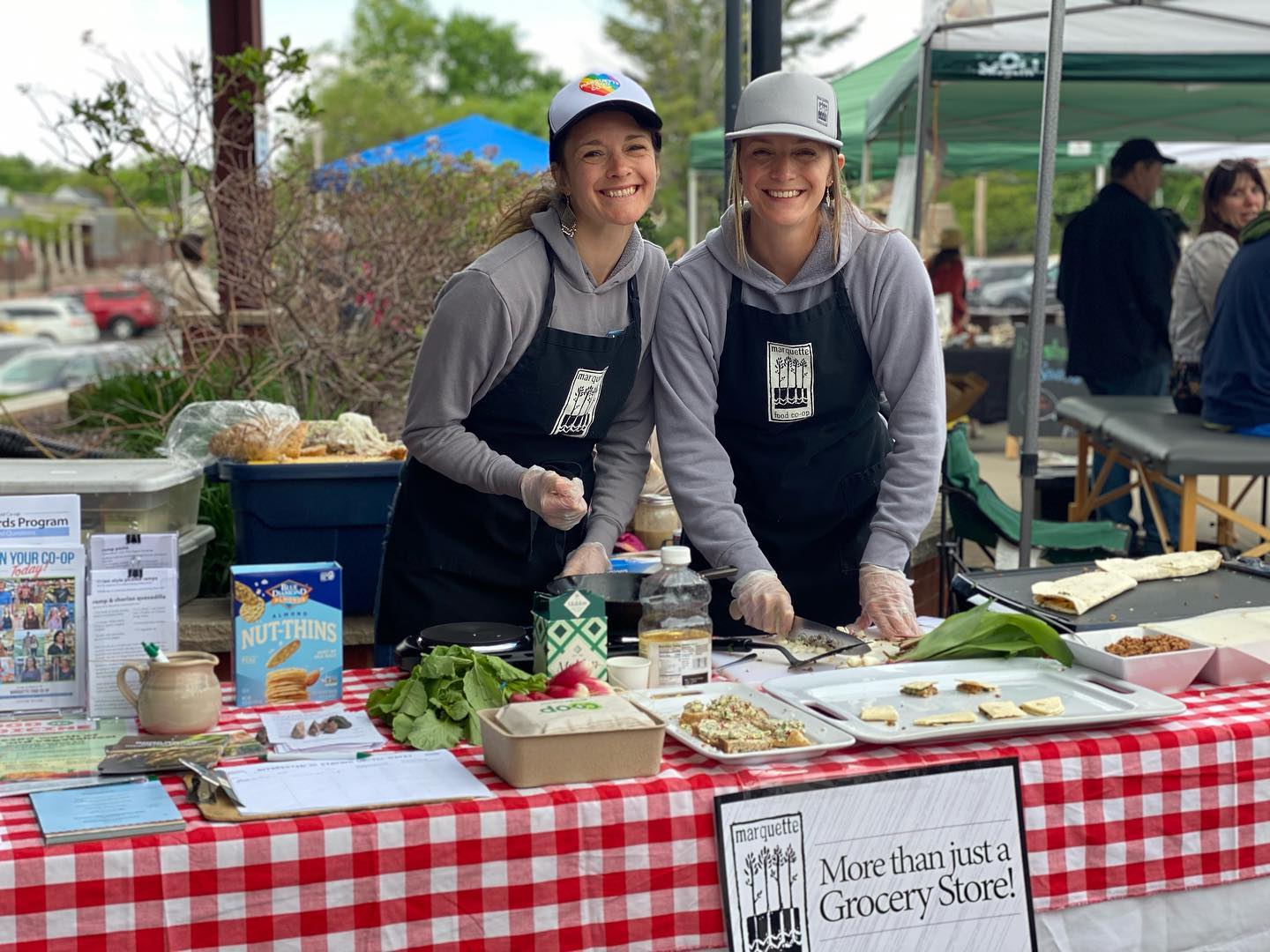
Sarah Monte, MFC Outreach Coordinator & Amanda Latvala, MFC Education Coordinator at the Downtown Marquette Farmers Market

One in 7 people in the U.P. are food insecure. At 14%, the U.P. has a higher food insecurity rate than the national average of 10.5%. Members of the U.P. community whose work is focused on food and health were invited to meet regularly to help direct these efforts. From those meetings, the Food as Medicine Partnership, a collaborative that is bringing Prescription for Health programs to communities across the Upper Peninsula, emerged.

This group, which includes twenty-five organizations, businesses, and individuals, envisions a collaborative food system in the Upper Peninsula that provides nutrition education and equitable access to wholesome, local, and affordable food for all residents. The first project the group took on is a Prescription for Health program, generously funded by the Superior Health Foundation. This Prescription for Health program is unique in that it addresses food access from both the customer and supplier side.

The Prescription for Health program uses a medical referral process for enrollment.

Participants receive a referral from a participating healthcare provider with a prescription for adding fresh fruits and vegetables to their diets. To qualify for the program, individuals must be at risk for or diagnosed with a chronic health condition, face economic barriers to food access, and be 18 years of age or older.

Participants enrolled into the program will receive vouchers to purchase fruits and vegetables from participating local farms. Each participant will receive a total of $15 per week during the 20-week season. The referral process is administered by the Upper Peninsula Commission for Area Progress (UPCAP).

A goal of Food as Medicine and Prescription for Health is to provide these services as widely as possible. The U.P. Food Exchange (UPFE), a collaborative local food network the Co-op helps administer, has members located across the U.P. and active in local food and farmers markets. Members were able to help identify and onboard farmers markets that could participate in the program.

This is more complicated than it sounds, as many markets in the Upper Peninsula are small and lack a market manager. For Prescription for Health to work, the market must have regular produce vendors and a market manager or fiduciary that can be a central contact for the Food as Medicine team to work with.

The current list of farmers markets includes:

Bay Mills/Brimley Farmers Market, Main St. Calumet Farmers Market, Depot Park Farmers & Artisans Market (Ironwood), Houghton Farmers Market, Hancock Tori & Farmers Market, Gladstone Farmers Market, Downtown Marquette Farmers Market, Munising Farmers Market, Newberry Farmers Market, and the Sault Ste. Marie Farmers Market. We hope that more markets can be added as the program continues.

A second focus of the Prescription for Health Program is to ensure that the farms receive support to help them increase the produce available at farmers markets. Farm debt is a huge problem across the country—even small-scale farming requires a high debt burden that is difficult to pay back, especially with an income that varies seasonally. UPFE and the Food as Medicine team want to help alleviate the debt barrier that keeps farms from starting or expanding.

The first ever UPFE mini grant program awarded nine farms $14,000 to increase their cold storage capacity. Funds can be used for the materials and labor to build new or additional facilities, as well as access to technical assistance for construction and HVAC. Grant recipients are also required to work with the U.P. Produce Safety Technician to ensure all the facilities and harvest systems are following best practices.

This funding will support the increase of local food production by ensuring that farms have a place to safely store produce until it can be sold.

Cold storage facilities are also essential for extending the agricultural sales season by providing space for keeping storage crops that can be sold well into the winter, directly supporting the growth of the U.P. farm economy and increasing access to local food for all residents.

This year’s grant recipients include Boersma Family Roots CSA and Farm, North Harvest CSA Farm, and Minnie Farms in the Western U.P.; Snowy Acres, U.P. Gourmet, and Full Plate Farm in the Central U.P., and Jere Farms, Gordon’s Produce, and Dutcher Farm in the Eastern U.P.

This grant program was developed in partnership with UPFE team members that include: The Marquette Food Co-op and the U.P. Food Exchange, Western Upper Peninsula Planning District Region (WUPPDR), Bay Mills College/Waishkey Bay Farm, Fresh Systems LLC, Renegade Sheep, the Marquette County Conservation District/Michigan On-Farm Produce Safety, Portage Health Foundation, and the North Farm/Upper Peninsula Research & Extension Center. Many partners were instrumental in spreading the word about the grant opportunity across the Upper Peninsula. And of course, the Superior Health Foundation funding made this possible.

A collaborative network is essential to make changes in our communities.

To grow our local food system and increase access to healthy food for all residents, we must work together. We offer our thanks to all the UPFE, Food as Medicine, and farm market partners for their work.

To learn more about the Food as Medicine Program, visit upcap.org/program/food-as-medicine or email Sarah at smonte@marquettefood.coop. To become an owner of the Co-op and support future initiatives like Prescription for Health, visit marquettefood.coop/owners/ownership.

*Article provided by the Marquette Food Co-op.

Excerpted from the Fall 2022 issue of Health & Happiness U.P. Magazine. Copyright 2022, Empowering Lightworks, LLC. All rights reserved.

Positive Parenting: How You Can Help Young Women & the World through STEM, Chris Standerford

Positive Parenting, importance of STEM, UP Holistic Wellness Publication, UP holistic business

Did you know you can help young women increase their ability to create a prosperous, satisfying future for themselves and others through STEM?

As defined by Michigan, STEM stands for science, technology, engineering, and mathematics delivered in an integrated fashion using cross-disciplinary learning experiences that can include language arts, performing and fine arts, and career and technical education.

By this definition, STEM is an integrated and authentic range of subjects and skills that work together and help us understand the world and find solutions to the problems we see. Put another way, humans are a part of both the natural and social worlds. Our curiosities and passions rely on skills such as observing, noticing patterns, understanding cause and effect, experimenting, troubleshooting, and so many more. These skills can bring joy and success to the things we love. And these skills are STEM skills.

As parents, we can help our youth recognize the parts of their identity that are deeply connected to STEM.

In fact, our communities need our help to inspire youth, particularly our young female students, to see themselves as capable, passionate, and successful in STEM.

Whether you love gardening, painting, tinkering in the workshop, yoga, paddling, camping, cooking, playing video games, performing, or lounging on the beach, STEM is a part of these experiences, and often adds a depth and a beauty to them. For example, when you garden, through understanding the needs of the plants you’re raising, you’re constantly learning and appreciating your garden ecosystem’s complexity and how amazing those plants truly are, much more so than if you simply picked up the same vegetables from the grocery store. As community members, parents, and teachers we can help our children realize that the things they love to do are in fact how they are making sense of the world.

To get started, let’s break down our actions into three simple things that might help us inspire our youth, particularly our young females, to consider STEM in their futures: Things we need to know, things we need to say, and things we need to do.

Things We Need to Know

As parents, mentors, and role models, we need to believe everyone can find joy, and yes, even a career in STEM so that the many complex issues facing the world today (i.e. social justice, medicine/health, energy, food shortages, climate change, etc.) can be better addressed. We need to first recognize that our own hobbies and interests are deeply connected to STEM in ways we perhaps haven’t fully acknowledged yet.

We also need to recognize and be aware of current trends and opportunities in STEM. Despite gains in the number of women pursuing some STEM careers, according to the National Center for Educational Statistics, women are proportionately half as likely as men to major in math, computer science, science, engineering, and technology. These fields are fast-growing, often more lucrative than those that were considered “women’s fields,” and in need of diverse ways of thinking. From data science to cybersecurity to advanced manufacturing, the need for talent and innovation is unprecedented.

Things We Need to Say

How we communicate is important; our choice of words matter. As parents, mentors, and role models, we must be diligent in how we talk about STEM with our children. First, we can communicate that it’s not about being ‘good at math or science,’ or finding the ‘correct answer.’ Rather, it’s about learning through our experiences and using our senses to notice things in the world, using our curiosity to ask questions about what we see, and leveraging multiple sources of information (i.e. text, conversations, pictures, experiences, models, etc.) to develop our ideas.

Second, it is hugely important to caution ourselves against sharing our own bias with students and unconsciously portraying STEM as difficult, overly technical, being largely for boys, or some of us not being good at it.

Have you ever heard an adult colleague, friend, or perhaps yourself say, “I was never very good at math”? This comment is easily spoken, but can leave a lasting impression on young minds. Much research has been done about the influence of our beliefs as a factor in feeling confident in our abilities in a subject.

We need to do better to foster a strength-based mindset when we talk about STEM with students. Start with what children enjoy and accomplish well, highlighting those skills and building toward new learning and new skills over time.

Things We Need to Do

As parents, mentors, and role models, we need to seek out opportunities for children to have supplemental STEM experiences outside of school. These experiences can be organized camps offered through local libraries, churches, science or nature centers, non-profits, museums, schools and universities, or simple, impromptu nature walks with family.

By encouraging students to make observations, look for patterns, and talk about what they are thinking, we open up their STEM mindset. We don’t need to have all the answers to their questions. We simply need to be willing to ask our youth to say more about their thinking, and to encourage them to develop their ideas and understanding.

If you are looking for more formal experiences, there are many resources in the Upper Peninsula and across the state to explore. The list below offers potential first steps, and connecting with your regional MiSTEM director may also help.

• Northern Michigan University Camps, Student Programs, and STEM degrees
• Michigan Technological University Camps, Student Programs, and STEM degrees
• Michigan Council of Women in Technology (MCWT) – K-12 Initiative
• Michigan Women Forward (MWF) – Empower Girls & HERstory
• STEMinista Project
• Photo Essay: Women in STEM from The Michigan Daily
• Michigan Learning Channel STEM for girls content: Future of Me – Explore STEM (science, technology, engineering, and math) careers; Career Girls – Career guidance videos

Chris Standerford serves as one of sixteen Regional Directors for the Michigan STEM (MiSTEM) Network. He works to connect, convene, and collaborate with stakeholders from business, community, and education. Mr. Standerford also serves as the director of the Seaborg Math & Science Center at NMU.

Excerpted from the Fall 2022 issue of Health & Happiness U.P. Magazine. Copyright 2022, Empowering Lightworks, LLC. All rights reserved.