What kind of world would we have without music? And what would Marquette County be like without its wealth of musical talent?
I started the Marquette Music Scene Hall of Fame seven years ago to show appreciation for all the marvelous local music that helps make this county such a special place. This year’s event will have the largest group of inductees so far! Every year I find more talent.
The 2023 Marquette Music Scene Music Hall of Fame is November 25th at 7 pm in the Red Room of the UP Masonic Center/MATI (Marquette Arts & Theatre Innovations) Theater.
Some of this year’s inductees probably should have been included in the first or second year, but sometimes something becomes such a part of your life that you come to accept and expect it.
Case in point—the Ray & Peg Hirvonen Foundation. Ray and Peg are like family. They’re the first people I got to know when I moved to Marquette County fifty-eight years ago. I never gave it a thought that they are Music Mafia. I knew they supported the Marquette Area Blues Festival, and Hiawatha Music Co-op, and Marquette City Band, and even the Music Hall of Fame through MATI for the past two years. But when their donation for the Presque Isle Band Shell became public, the light in my brain clicked on, and I realized they are Marquette Music Scene Hall of Fame Music Mafia.
This year’s inductees include another huge list of Marquette County talent.
We will recognize and induct the Hirvonen Foundation, Marquette County Choral Society, Marquette City Band, Negaunee Male Chorus, Dixieland Band, Frank Smith Trio, Don Bays, Janice Shier Peterson, Deborah Bengry, Kurt Gronvall, Kim Lenten, Toni Saari, Vicki Tickinen, Plaid Billygoats, Paul Dornquast, Tom Vadja, Paul Neumann, Warren Hantz, Esther and Eino Olander, Smarty’s for Rising Star Venue, and Waterfront and Brookton Dance Hall for Venue History.
We gladly accept nominations. Often I hear, “How come so-and-so isn’t in the Hall of Fame?” My best answer is “Nominate them!” There is a nomination form on our Facebook page, which will also be at the induction event, or you can email me a name and information about them at ceracer24@aol.com, or mail to 380 Karen Road, Marquette.
I’ve been working from the talent I know about, and I’m always grateful when you let me know of someone who’s been part of the music scene for at least twenty-five years (unless you’re nominating them in the Rising Star category).
I hope to see you November 25th at the party! Come dressed up or in your music tee shirts. Walk the red carpet and take lots of pictures!
Cindy Engle is an artist, reflexologist, event organizer, positivity pusher, and music and art supporter. managing OutBack Art Fair, Marquette Music Scene, and MMS Music Hall of Fame, and, best job-grandma.
Excerpted from the Winter’23-’24 issue of Health & Happiness U.P. Magazine, copyright 2023, Empowering Lightworks, LLC. All rights reserved.
A tree is all the trees around it. An entire forest is one living breathing thing.
Yet trees touch sky, a scraper, a whisk to clouds of the blue dome above.
The canopy of trees keeps a space between each tree’s branches, a respectful distance an unspoken blind boundary.
Underneath they are holding hands. Roots send messages, I am in trouble protect yourself, grievances they do not hold among themselves.
Minerals mined with roots shared. Trees leave inheritance, treasure to the family rooted around them. An Aspen to an Oak a Spruce, to a Sycamore, a Hemlock to a Cedar, a Birch or Maple.
I love you take what I have, be well. Live and pass it on when your time comes. If only we were like trees.
Touch sky, not to crowd or compete, only to share, mingle roots, hold hands with the earth.
Poet Lisa Fosmo lives in Escanaba. She is the author of a full length collection of poetry. Her book “MERCY IS A BRIGHT DARKNESS,” newly released through Golden Dragonfly Press, is available on Amazon and Barnes and Noble.
Excerpt from the Fall 2023 issue of Health & Happiness U.P. Magazine, copyright 2023, Empowering Lightworks, LLC. All rights reserved.
How amazing it is that Lake Superior Theatre (LST) has been part of the waterfront for twenty-five years now! Since we began all but one of the Blockbusters closed, along with a plethora of other changes in technology. Everywhere we go, we are on Wi-Fi! We have tablets and mobile phones that do many of the things we used to do on those big desktops we had in 1999 and we’re ordering everything we cannot find in town on them. You probably used your smartphone’s GPS to find the theatre the first time, or to check LST’s website or Facebook page to see what show is playing.
LST was begun when Beacon on the Rock was written for Marquette’s sesquicentennial. In looking for a location, we discarded the idea of a tent due to wind, water, heat, and the biggest issue… late darkness. We found the acoustics of the boathouse (just north of Mattson Lower Harbor Park) wonderful, and LST was born.
The boathouse is a historic building where iron lungs were built by Maxwell Reynolds during the polio epidemic, so it has always seemed fitting that Lake Superior Theatre focuses on presenting and preserving our past. Beacon on the Rock is a key part of LST’s past, and also a tribute to those ancestors who came to this harsh, isolated region to build a new life landing on the shore where it’s located. History recognizes the contributions of Peter White and others, but Beacon is about the ordinary people who endured a harsh life to settle this area and became “spelled” by Lake Superior. Beacon reminds us too that we are all immigrants seeking a better life. The families in Beacon left all that was familiar to them and came to a place that provided unimaginable challenges. They brought only their creative energy, intelligence, independence, persistence, and willingness to work hard.
I often think that if we could test immigrants for these qualities, we would find they are built into their DNA, genetically passed along to future generations, and have served this country well. We hope those who came to Beacon are motivated to hear the story of an immigrant, perhaps in their own family, who came to America. We hope you will ask them to tell you their story, and that you will treasure and share it. We are so proud of these amazing individuals of diverse cultural heritage and talents!
As with most any person or group facing challenges, at times during LST’s twenty-five years we were uncertain about our future.
each year, we made progress and improvements and thrived. The lifespan of summer theaters varies greatly, as many factors can influence their success and longevity—availability of funding, quality of productions, audience size, and the theater’s ability to adapt to changes in the market and cultural trends. Some may also face challenges related to competition from other forms of entertainment or changes in the local community that impact attendance. Many only operate for a few seasons before closing, while rare others continue for a decade or more. LST’s beginning its twenty-fifth season is a testament to its appeal.
LST is at a pivotal time of its life, leaving some to wonder openly what its future might be. Having a Board that embraces the future of LST is crucially helpful. Additionally, I am an eternal optimist and know that our mission to enhance and embrace live theatre in our area is firmly viable. We are a nation of individuals who relish rising to challenges; a people that don’t see the impossibility of a task, but instead look for the possibilities… and push the envelope to accomplish them, just like the families in Beacon on the Rock.
LST has been able to build a loyal audience over time and establish itself as a cultural institution and tourist attraction in the Upper Peninsula, helping to ensure its continued success and longevity. By introducing young and old alike to live theatre, it has contributed to the artistic world.
LST has benefited from MACC and NEA grants that are awarded through a peer review process. MACC grant awards require matching those funds with other dollars. We thank our sponsors, supporters, and those who made donations at any level, and recognize them in our summer program. Our LST fundraiser is Monday July 10th this year, and features Broadway stars. However, every donation in any amount is so appreciated!
Kudos also to the cast and crew who donate their time and work tirelessly each summer.
We often remark on how they bring the boathouse alive with magic, and it seems this year it will not just come alive, it will burst into our twenty-fifth anniversary season with vibrancy that will bring down the house!
It’s such fun sharing our passion with you, and your supportive comments are so appreciated. Life teaches us so many things, and I have learned so much through LST. It is what we learn that matters. So if you have always wanted to visit the boathouse, now is the time to do it! This artistic jewel with the million dollar lobby view will present our signature musical, Beacon on the Rock, followed by I Love You, You’re Perfect, Now Change, Jersey Boys, The Odd Couple, Honk Jr., and Superior Memories this summer.
Beacon will be performed July 5-8. It was written by Shelly Russell and she will direct it this year. On July 11-14, enjoy the funtastic I Love You, You’re Perfect, Now Change, directed by Leslie Parkkonen; it hones in on the awkward, cumbersome, tricky nuances of dating life with witty quips and cutting-edge lyrics. July 18-29, Jersey Boys will take the stage, directed by Eliisa Herman. This show features the electrifying songs we all love in this summertime spectacular tell-all sensation! August 1-6, we present the amazing comedy The Odd Couple, directed by Denise Clark.
Our collaboration with Superior Arts Youth Theatre in Honk Jr. August 8-20 will be directed by Caitland Palomaki, and is a show that touches our hearts. On August 21, we host Jack Deo, Jim Koski, and Bob Buchkoe with their program about silent film footage from 1914-1949: Lights, Camera, Marquette. On the 22nd, we welcome Broadway to Blues with Tony Beacco, Ann Berchem, and Keith Cahoon. On the 24th, B.G. Bradley returns with Northwords & Music. On August 23rd and 25th, the Franklin Park Band returns to take us back to beloved songs of the Sixties. The band has traveled to our often-frozen “tundra” for several years to support LST, and we are so grateful for the way they boost our spirits. You may walk in with a cane but leave dancing in the aisles!
Tickets always sell out fast for these productions, so get them now.
Show information is available at lakesuperiortheatre.com, Facebook, the theatre, and the rack cards holders of the former ticket office in the Lower Harbor. You can visit the Berry Events Center (or Forest Roberts Theatre, depending on construction progress) for your tickets, call Northern Michigan University’s ticket system at (906) 227-1032, or book your reserved seat online directly at tickets.nmu.edu.
Shows begin at 7:30 p.m. with the exception of the Sunday matinees at 3 pm. Allow some extra time to enjoy the short walk to the theatre after parking in the Lower Harbor so you can soak in the Superior vistas of our domain. We have limited disability parking and always have drop-offs available. Most of you who return to LST annually know all this, of course, but we are always amazed at how many people are unaware of the theatre gem hidden from view on Lake Shore Boulevard.
Make time during your busy summer to let us entertain you…. as well as inspire, educate, and enlighten you! Our mission of being a gathering place for the community to engage in educational opportunities and enhance their understanding and enjoyment of life through the creation and presentation of the arts has led LST to welcome more than 100,000 people since 1999. We invite you to join us in 2023 and enjoy our exceptional live experiences. See you at the Boathouse!
Peggy Frazier has contributed to the fields of pharmacy, education, theater, and women’s rights. She was Pharmacy Director at NMU, worked administratively in promoting gender equality and disability rights, and demonstrated her public service commitment on FSU Board of Control and Michigan Board of Pharmacy.
Excerpt from the Summer 2023 issue of Health & Happiness U.P. Magazine, copyright 2023, Empowering Lightworks, LLC. All rights reserved.
The late Helen Haskell Remien inspired many in our community and beyond to greater creativity, boldness, and optimism, to claim their talents and live more fully. In 2007, this grew into her opening Joy Center, expanding the depth and reach of her impact.
Helen described Joy Center as “a charming cottage in the woods in Ishpeming that’s a creative sanctuary for people in our area and elsewhere to come and play and dream and expand…. a beautiful place where you can connect with your biggest, highest part, and also connect with the community.”
As Helen explained, “I had a seed of a dream in me thirty years ago. At that time I was wondering if I wanted to be part of the academic world, in an institution, and teach writing, or part of a place in the community where things like writing workshops could be held in which everyone could be included. I wrote in my journals in the early 90s that there should be a place in the community where we can drum and sing, and dance, and have writing workshops, and events like ones I loved when I went to Omega Institute and Kripalu, and that I would love to be a part of something like that.
“About twenty years ago, I began encouraging people to find their own creative paths.
Then in the spring of 2007, I started to feel dissatisfaction…. It was no longer enough to teach writing in my house and yoga in the basement of my husband’s dental office.”
“When I built Joy Center, I kept expanding my mind—‘This will be a place where I will teach yoga, writing, creative workshops. And people can offer other creative things. It will extend our home in some way when our kids come back to visit….’ I realized, ‘Oh, my gosh! There are so many awesome dreams people are having in the community!’ And at that point there weren’t the places available now offering yoga and energy work and so on.”
“For example, Amber Edmondson and Raja Howe knew they were poets, but didn’t know they were book binders yet. They sold a book at Out Loud, our open mike night, then began offering book-making workshops at Joy Center. Now they have their own shop. Kerry Yost had never sung in public until one night at Out Loud, and she just blew everyone away.”
“Early on, Joy Center took on its own life to be a safe place where people could take a seed of a dream, like I did, and allow it to blossom.
Sometimes their offering has stayed at Joy Center, and sometimes it flourishes far beyond. And I get to play with people that way, and be the person who holds the space and is a cheerleader for people’s dreams.” “ “I think people feel something when they walk into the physical building because it’s really welcoming and beautiful…. People feel safe to really be brave and find parts of themselves they haven’t felt before, or to love themselves more deeply than they’ve loved themselves before. Joy Center was built with a really positive, high vibration…. It was such fun working with a young man who put his heart and soul into it…. We really co-created together, him doing the actual work, and me doing the dreaming.” (1)
Helen’s dreaming supported some as-yet-unknown dreams of others. Singer/songwriter Kerry Yost explains, “She made you feel like what you were doing was important and worth sharing, and created a space for it to become important and worth sharing through her support and encouragement and also through the community she built at Joy Center. She gathered all these people who wanted to create meaning in their lives, and gave them a space and encouragement to do that.”
“As a bigger-than-life kind of person, she had that level of impact in everything she did—within the writer community, yoga community, artist community.
Even though she had such a far reach, Helen still made me feel like that reach went directly to me specifically. I think she had that effect on many people.”
Her biggest impact on me was with my music through her encouragement and sometimes outright loving pressure to make something of what I was doing. Most of my music is just in my house for me. Helen would say, ‘Kerry, so when are you coming to Out Loud to play music next? Here’s the calendar, pick a day when you’re going to have your show at Joy Center.’ I’d be like, ‘I don’t know, Helen. Nobody needs to hear that.’ Next time I’d see her, she’d say ‘Okay it’s January; what day do you want to do that?’ and I’d turn her down again. This went on for a solid three months.
Helen could have kept what she built for herself, but instead she used her resources and energy to build Joy Center for others to utilize. She was also like, ‘And it’s for me too!’ I love that she was so real about it, unabashedly so! She took her dream and made that same dream accessible to others and encouraged them to do it because she had the privilege to do that for herself.
I remember going to Joy Center and hearing Christine Saari read excerpts of her work and being completely entranced by the stories of her childhood. I got to hear Keith Glendon play ukulele in front of people for the first time. She created space for people both physically and in a very deeply spiritual way.
Helen really did see and want to help people where she could.
She invited me to be the Joy Center gardener, even though I knew nothing about doing that, back when I was a broke part-time social worker, part-time musician. I always felt very cared for by Helen. She’s so special to me, and everyone, for good reason.”
Keith Glendon recalls, “I found Joy Center when there was a lot of chaos in my life. And in finding it, I also found the heartful community that I didn’t have here even though I’d moved back to my hometown—people like Kerry Yost, Matt Maki, Christine Saari, and all these folks that would turn up at Out Loud and nourish a part of me that had been put away for a long time. That really began the rebirth of my creative self, my authentic self, my healing self, my musical self. Joy Center was a great place of friendship, safety, respite, and renewal.
“I’d been about to go back to school for my MBA, but I didn’t really want to. I was just searching for something. I went to a grueling three-hour session of a 12-week GMAT prep course and thought, ‘What am I doing?’ I went to Out Loud that Thursday and discovered Matt Maki was starting an Artist’s Way class. I thought, ‘I could do this thing I don’t bleeping care about, or I could do this class with this weird dude who’s a poet. Why would I condemn myself to a future in what I don’t want to be doing?’”
“My experiences at Joy Center also began to influence my children with both poetry and music. Now I have a teenage daughter who’s very adept at busking and singing and art-making.”
“Helen even inspired a big project of mine.
During one of her monologues at Out Loud, she said, ‘It feels so much gooder when I’m able to step into my bigness.’ I said, ‘Hold on—can I use that?’ And that became the title of Gooder with Bigness, a Shel-Silverstein-meets-Dr.-Seuss kind of book I’m creating with Hancock artist Katie Jo Cudie.”
“Joy Center literally changed the course of my life. It resuscitated an essential me that had not had nearly enough nourishment and exposure and attention.”
Ishpeming resident Cece Korpi’s time with Helen at Joy Center led to a turning point in her life too. She explains, “A friend recommended her yoga class. When I found out it was an hour-and-a-half, I said, ‘I cannot do a class that long, but I’ll give it a try.’ Helen welcomed me with open arms. When the first class was finished, I felt like—“What?! I don’t’ want to go home. I just want to stay here!”’
Helen loved life and people, and shared her joy every day.
At the end of yoga class she would say, ‘All is well,’ and I would think ‘You do not know my life!’ But I took more classes and I learned all is well in this moment.
Helen was so accepting of everybody. By spending time with her and going to a lot of Joy Center offerings, I became more accepting of myself and others. Her joy and compassion were contagious. I came out of my shell and became more confident.”
Like Helen herself, though Joy Center is no longer with us physically, its spirit continues to inspire. Keith Glendon describes a “Joy Center Junior” shed in his backyard where the adults can do art and music. In the spirit of Out Loud, Keith is working with Marquette’s Unitarian Universalist Church leaders to offer Music & Myth Monday, where youth can play music live, or music they like, or read mythology they’ve enjoyed that has spiritual meaning.
UP Poet Laureate Marty Achatz continues the Out Loud tradition each third Thursday on Zoom. All are welcome to join in, whether as listeners or by taking a turn on the Zoom “stage.” You can email him at machatz@nmu.edu for info.
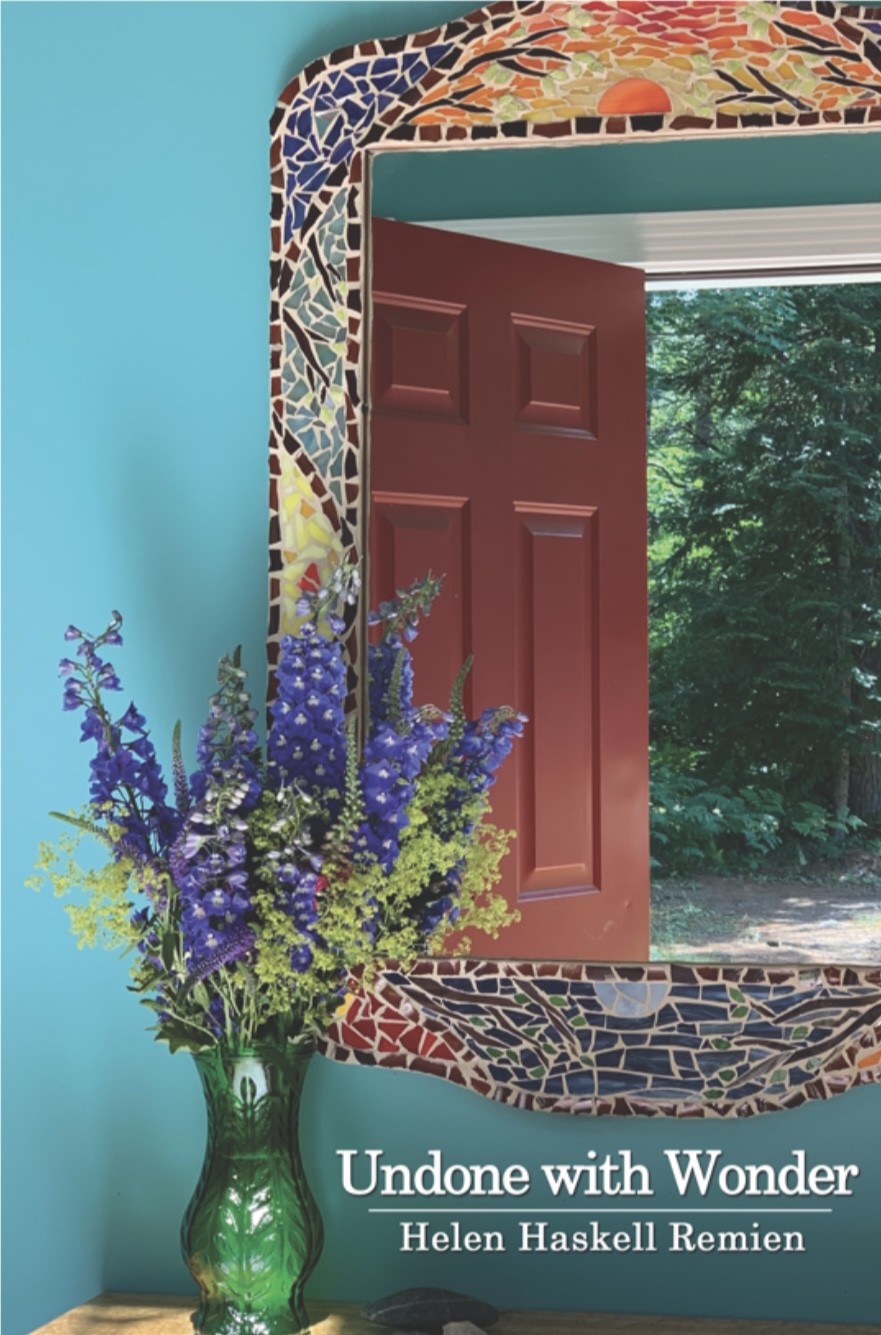
You can also dip into Helen and Joy Center’s creativity and beauty through Undone with Wonder, a poetry collection Helen had been working on now painstakingly published by poet friends Gala Malherbe, Marty Achatz, and Ron Ferguson, with an inviting cover photo of Joy Center’s entryway by wellness consultant and former Joy Center manager Pam Roose, and a warm introduction to Helen by local author B.G. Bradley. Copies are available at the Marquette Regional History Center gift shop and Blackbird Boutique in Marquette. All profits go to the Peter White Public Library.
Ideas are also percolating for a Joy Festival later this year. See the Summer 2023 issue of Health & Happiness UP Magazine for more info.
1 Health & Happiness U.P. Magazine, Spring 2020 issue, copyright 2020.
Excerpted from the Spring 2023 issue of Health & Happiness U.P. Magazine. Copyright 2023, Empowering Lightworks, LLC. All rights reserved.
L’Anse-raised Mary Wright was a homesteader, a teacher of health education, English, history, and art, a cancer survivor, and a feminist. Most people remember her, however, as a community art organizer.
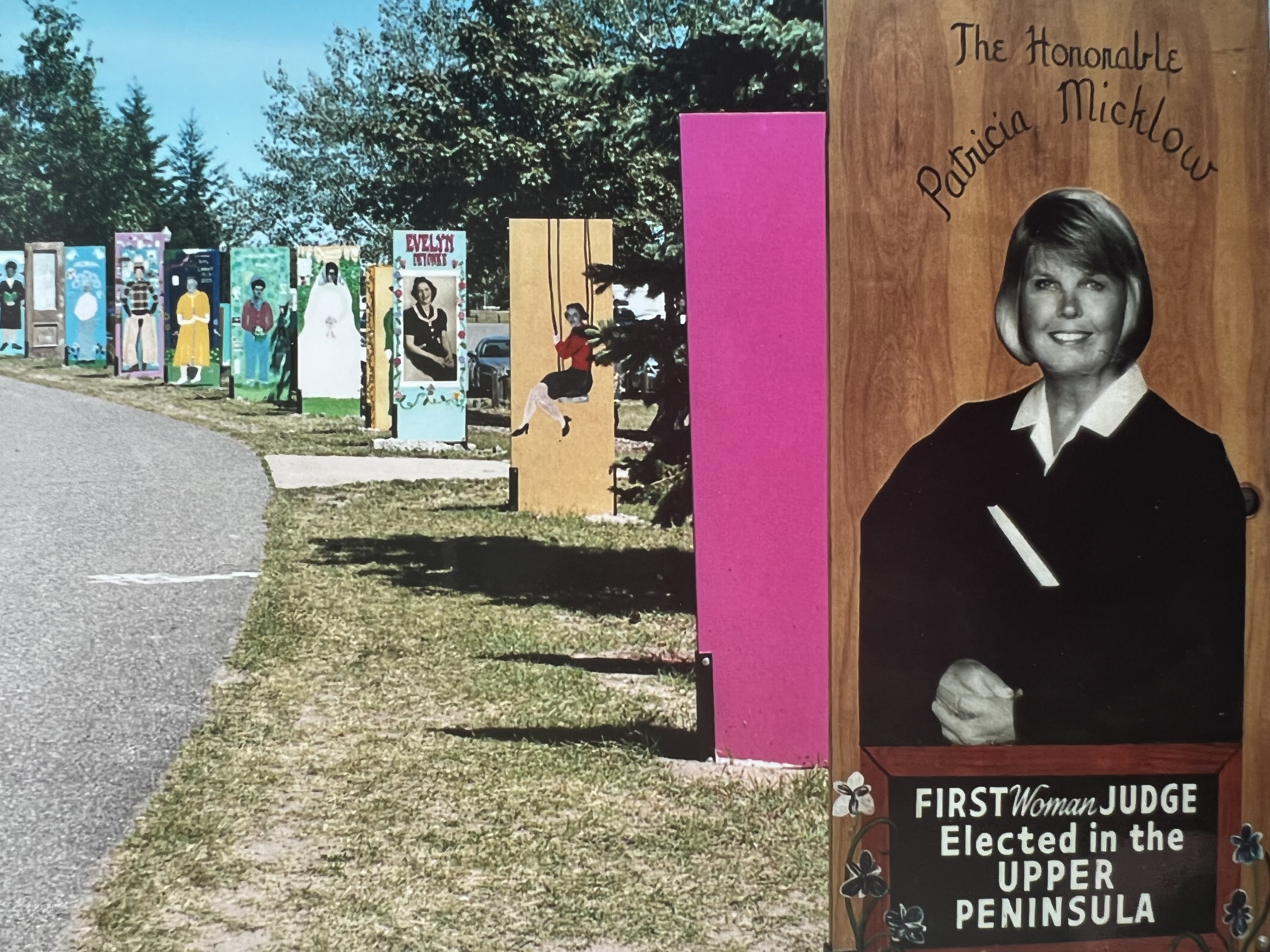
Well over three-thousand blue and white hand-painted chairs brightened NMU’s campus during FinnFestUSA 1996 and 2005. 50 colorful fish shanties appeared at the Lower Harbor parking lot during the World Winter Cities Conference held in Marquette in 1997. Residents painted 400 book covers to represent their city block and raise money for their library. The history of pioneer settlers and families of today were recreated on one of the 500 Heritage Family Poles, set up to celebrate the Marquette Sesquicentennial in 1999. In 2007, 200 doors told the stories of grandmothers, past and current. Over the years, many thousands of people participated in these and other projects, and uncountable locals and tourists viewed them.
When Mary Wright dreamed up these community efforts, the sky was the limit.
No idea was too big or impossible to carry out. Her criteria for any of these undertakings were straightforward: The project had to involve fun, collaboration, and community spirit. Mary believed that every person has the capacity to be creative if provided the opportunity, and that working on joint art projects, reflecting the spirit of old-time barn-raising events, could create miracles.
This community aspect was essential. All participants, from elementary school child to grandmother to prisoner, were welcomed. The wilder the inspiration, the better! If you wanted to cover the wall of your fish shanty with left-over socks gathered at laundromats, or hang shoes of your relatives from your family tree, why not?
Mary Wright’s Doors Project
To make these complicated events happen required multiple skills. Mary had a knack for roping people in, persuading them to help paint a mural, create a prototype, drive logs from Munising to Marquette, give money, or procure materials. She networked with local and state art organizations, city government departments, labor unions, and corporations, found donors and sponsors, and worked with the news media. She made countless presentations in schools, clubs, and to any group. And she did it all without a computer or the Internet! Her persuasive powers and persistence were legendary. Mary Wright did not take “no” for an answer.
Mary Wright had a special gift for finding the perfect expression of a particular event:
Blue and White Chairs, Finland’s national colors, were the perfect symbol for FinnFestUSA, an annual international festival held each year in a different city. They gave people of Finnish heritage a chance to honor their families and to define what being Finnish meant to them. They were an expression of hospitality, an invitation to sit down to strike up a conversation, to recycle old furniture, to create an heirloom. All fifteen UP counties participated. Chairs were set up by their painters’ regions, so visitors could find the chairs, benches, stools, and rockers they had decorated. A calendar was later created to provide a lasting souvenir of the event.
Mary felt Fish Shanties symbolized the spunk, spirit, and sisu of UP winter culture. Some grandparents used them to create playhouses for their grandkids. Book Covers were a natural for a library fundraiser. The project was organized around city blocks. This created special pride for residents and helped distribute the covers widely. Family Poles were perfect to portray the 150-year history of Marquette. The many different stories of individual families and organizations told through these poles formed a kaleidoscope of the community’s past and present.
Mary Wright learned how to draw the attention of the news media. Her flamboyant way of dressing in bright exotic costumes, colorful hats, and artful jewelry made her stand out. She managed to get herself on the Today Show in New York, at which she presented a bench decorated with portraits of the show’s luminaries. In the days before drones, she had an aerial photo taken from a helicopter to help advertise her book project. Family poles rode in the Fourth of July Parade. Outdoor working sessions gave visibility to a given project. There were interviews, photographs, and editorials in the newspaper.
Mary’s unique style is featured in Yoopera, a film documenting the production of the Rockland opera and the creation of Mary’s Storyline project in which thousands of white panels strung on wires fluttered in the wind like layered prayer flags from their spots around the Rosza Center and more Michigan Tech campus areas. Primarily made by schoolchildren, each panel had a photo transfer of someone’s image and the story of that person’s life told in the first person.
Mary Wright’s activities were not restricted to Marquette and Houghton.
She organized over thirty-five community projects, including in places like Alpena, Ypsilanti, and Port Huron, and also worked internationally in Toronto and Finland. Her themes were often based on ordinary objects such as shovels, stepladders, pillow cases, spring flowers, or winter mittens. In 1999, she received Michigan’s Governor’s Award for Arts and Culture.
Participating in one of these community projects has had a lasting impact on many. Often it was the first time someone had created an art object. Mary Wright supporter Doug Hagley said about Family Poles, “Some families were reunited after years of separation. Dialogues were fostered… Children honored their parents and grandparents…. The community and its visitors experienced the healing and community-building power of art.” School children became interested in their family history and realized that you could be an artist at any age. Poet Sandy Bonsall’s experience painting blue and white chairs with her students prompted her to write My Mother’s Story Is My Story. I myself was inspired to create a family pole to explore the Finnish background of my husband, and Grandma Doors led me to research the life of my Bavarian grandmother whom I had never met.
We lost Mary in November 2021. To honor her and her work, the Beaumier Heritage Center at Northern Michigan University will feature her in an exhibit in the spring of 2023. If you are willing to loan Mary Wright project object for the exhibit, please contact Dan Truckey at (906) 227-3212 or email heritage@nmu.edu.
Austrian writer and visual artist Christine Saari has lived in Marquette since 1971. She has published memoir Love and War at Stag Farm (2011) and poetry book Blossoms in the Dark of Winter (2018). Find her visual work at The Gallery and Wintergreen Hills Gallery.
Excerpted from the Fall 2022 issue of Health & Happiness U.P. Magazine. Copyright 2022, Empowering Lightworks, LLC. All rights reserved.
As we move into U.P. spring, it’s hard to know just how gradual this movement may be, how long a gray, muddied limbo between snowy wonders and warm blossoming may go on, and how many restrictions, challenges, and losses we may need to weather through this time. These possibilities alone might nudge us to descend into the doldrums.
But we don’t have to feel diminished by any of this. We can choose to expand our world by exercising our innate creative capacities. In my years teaching visual art in public schools, I saw over and over again how by a certain age, most kids would decide they were good at an art or not. That inner critic can loom so large that many who did not see themselves as “the artist,” “the singer,” “the musician,” etc., might never participate willingly in such activities again.
Do you have to excel at fishing to go fish? At cross-country skiing to go ski? Creativity is part of human nature, and much-needed to come home to ourselves, reduce stress, and increase self-expression and novelty. And if anything is going to combat the stay-at-home same-old same-olds, it’s novelty!
So no matter how rusty, shoddy, or splendid you may believe your creative abilities are, you can take some time this season, even for a few minutes at a time, to juice up your life through your creativity.
If you feel at a complete loss as to where to begin, check out what kinds of guided creative experiences might be available to you locally or online, and pick one that sparks your curiosity. If you already know of something creative you enjoyed doing as a kid, consider exploring a do-able version of it that excites you now.
If you create regularly but feel you’re in a bit of a slump, try a new art form.
It’s likely to take you in a new direction and/or spice up your old one.
If any of these suggestions make you nervous, that might just indicate you’re on the right track! As artist Henri Matisse once said, “Creativity takes courage.”
If an act is truly creative, it’s a step into the unknown, so there will be plenty of opportunities for your inner critic or inner curmudgeon to try to hold you back. But you can decide which part of you is in charge, and go for it anyway, if only for the pure daring of it!
So, here are some solid do’s and don’ts to help you along the way:
DO create a regular routine of creative time. Don’t wait for inspiration to descend from on high. While it‘s wonderful when that happens, research shows habitual creative time not only increases how much you create, but also helps you generate new creative ideas. So if you’re not creating regularly, put it in your calendar, repeatedly, even if for short bursts of time after prepping in advance.
DONT try to critique or refine your creation at the outset. There will time for that later. The beginning is the time for the rough sketch, the raw draft, the stumbling notes. It’s the time when a field full of possibilities is being explored. Newly-born humans don’t walk, and newly-started projects don’t usually seem like masterpieces. Nurture this tender stage. And if you choose to share this part of your process, only do so with those you can trust one-hundred percent to cheer you on.
DO open up to new experiences. They can trigger new creativity, even if seemingly unrelated.
DO your best to open up your senses more fully to what’s around you. Listen, look, smell, feel, sense with greater attention, and you may find new inspiration even in familiar surroundings, as well as feel more fully present and alive.
DO shake things up if you get stuck–create in a new or even unusual location, do a repetitive non-creative task, or go for a walk. In fact, the connection between walking and creativity has been confirmed by research. According to a 2014 Stanford University Study, a person’s creative output goes up an average of 60% when walking, whether indoors or out. (And a little personal confirmation—ideas for this article came to me while out on a walk.)
DON’T become overwhelmed by a big idea or project you may have come up with. Chunk it down into manageable steps, and even micro steps if needed.
DO remember that everything man-made once existed in imagination only, and honor that magical capacity within yourself and others.
DON’T listen to the naysayers in your head or your life. Be bold, and put your attention on your freedom to choose to create instead.
DO remember that creativity includes more than fine art. It can also be how you put together a meal, a gift, a room, a schedule, resolve a challenge….
DON’T use the truism above to justify shying away from a creative activity that intrigues you.
DO hang around with other creative people. Creativity can be contagious!
DON’T imagine what “others” might think or say about your creation. It’s none of your business anyway. Your job is to nourish your creative faculties.
DO get enough sleep. The brain requires adequate sleep to process ideas and to function well. And the rest of you needs sleep to be able to carry out your creative ideas effectively.
Roslyn Elena McGrath supports fulfilling your innate potential through soul and intuition-based sessions, classes, and products at EmpoweringLightworks.com, and publishing Health & Happiness U.P. Magazine.
Excerpted from the Spring 2022 issue of Health & Happiness U.P. Magazine. Copyright 2022, Empowering Lightworks, LLC. All rights reserved.
U. S. Poet Laureate Joy Harjo says, “If you do not answer the noise and urgency of your gifts, they will turn on you. Or drag you down with their immense sadness at being abandoned.”
Gifts are strange things. They come to us out of nowhere. Surprise and fill us with pleasure. There is power in unwrapping a gift. Beneath the bows and paper, in the darkness of the unopened box, anything could exist. A box of chocolates. Music box. Book. Tickets to Walt Disney World. Words.
Yes, words. Because I’m a poet, I have always believed words are gifts. Think of the word “cleave.” It can mean to “divide or split as if by a cutting blow.” But it can also mean to “adhere firmly and closely . . . unwaveringly.” In one word, there is both separation and connection, loss and love. That’s a remarkable gift.
Back in January of this year, I received an email about a grant program sponsored by the National Endowment for the Arts called the Big Read.
The NEA Big Read involves organizations creating programming centered around the themes and ideas of one book. Part of that programming involves giving away copies of the chosen book to community members. A gift of words.
One of the options for the 2021-2022 NEA Big Read cycle was U. S. Poet Laureate Joy Harjo’s poetry collection “An American Sunrise.” Filled with cleaving (the removal history of Harjo’s people from their homelands) and cleaving (love poems for Harjo’s mother and husband and children), the book spoke to my artistic gifts.
So, I set about writing an NEA Big Read grant. I pulled together partnering organizations, contacted artists and writers, planned events—keynote addresses, poetry workshops, art exhibits, and a chapbook contest. I dreamed big. It was like writing a detailed, twenty-page letter to Santa Claus and dropping it in the mailbox.
The dream was simple in concept: to build bridges. I wanted to highlight the history, culture, and contributions of indigenous peoples. Through Joy Harjo’s words, I hoped to create a dialogue across the Upper Peninsula and bring people together. Using poetry as a vehicle, my NEA Big Read dream would hopefully be a catalyst for cultural understanding and change.
This dream was a gift to me.
A noisy, urgent gift, as Joy Harjo says. And I followed Harjo’s advice: I didn’t ignore that gift.
Several months after sending off my “letter to Santa,” I received an email one morning from Arts Midwest, the organization that administers the Big Read program for the National Endowment for the Arts. That email had one word in its subject line: “Congratulations.” I sat in my office for a few moments, feeling a lot like a kid on Christmas morning, knowing that my dream had become reality.
As I sit writing this article, I’m approaching the final weeks of programming for the NEA Big Read at Peter White Public Library. Over the past month, I’ve heard the Teal Lake Singers Drum Circle perform. Listened to poets and scholars and teachers of Anishinaabemowin. Soon, I will have the opportunity to speak personally with Joy Harjo, listen to her read her poetry, ask her questions.
However, the path to my NEA Big Read dream hasn’t been without its share of struggles, personal and professional. Sickness occurred. Scheduled speakers became unavailable. Loved ones passed. Events needed to be rescheduled or completely reinvented at the last minute. Big dreams are like that. They rearrange themselves like waves rearrange a shoreline.
But dreaming big is important.
Paying attention to your gifts (no matter what they are) isn’t just important. It’s necessary and life-sustaining. Sharing those gifts and dreams with others can be a powerful force for good in the world at large.
One of the events of the NEA Big Read was a three-day poetry chapbook writing competition. Participants were given a list of eighty writing prompts to spark their creativity. One of the writing prompts was this: Make a list of things you want to do today. Let your imagination run wild with the list, accomplishing impossible things.
Try it right now. Make that list. Dream big. Dream impossible. Use your gifts. Make the world a better place.
Martin Achatz is a husband/father/teacher/poet/dreamer who lives in Ishpeming. He is a two-time U.P. Poet Laureate and teaches in NMU’s English Department. He also serves as the Adult Programming Coordinator for Peter White Public Library, where he recently organized and ran the NEA Big Read.
Excerpted from the Winter 2021-22 issue of Health & Happiness U.P. Magazine. Copyright 2021, Empowering Lightworks, LLC. All rights reserved.
In many ways, poetry workshops during the pandemic have been like physical workouts with a group of friends. We all agree to meet in the Zoom “Fitness Center,” the one on the corner of Comfy Chair and Computer, around 7 pm. Over the course of two hours, we try out three different “machines” (writing prompts) that, if all goes well, get our hearts going and stretch us in new ways so our poetry muscles grow. After each exercise, we take turns flexing in our rectangles. We make each other laugh, and sometimes laugh at ourselves. We take risks. We virtual-hug. Most importantly—we feast, passing around encouragement like delicious sides to the main course, which is always We Hear You. Workshops can be a worthwhile discipline for poets, and often lead to joy and revelation.
But sometimes things don’t go as planned. We stare at the blank page and, even with a carefully crafted prompt, nothing comes. The ten-minute time limit ticks away. Maybe we pray. Maybe we panic. If we’re lucky, inspiration makes an appearance before the end, and we scribble until the last second (or after). No time for options. No time for second-guessing. Barely legible. Is it intelligible? Who knows? But at least we have something to share. This is a great strength of the timed prompt—it forces us to write something, anything.
Adding a wrinkle to the format can make the experience even better.
For many poets, getting started is half the battle. For some, it is the battle. It’s not uncommon for poets to collect kernels of inspiration throughout their life. These might be lines of poetry without a home, images, stories, snippets of dreams, random articles, overheard conversations, and more. Lists can get long; inspiration folders can get thick; and there’s always the danger of our kernels remaining, simply, “great ideas I once had but never used.” That is, unless these kernels find a home.
For this reason, in the poetry workshops I’ve been leading, I give participants a three-minute brainstorming prompt—a way of collecting kernels in real time—before they’re challenged with a poetry prompt. When I attend workshops led by other poets, I often bring a single page filled with unused kernels of inspiration. Sometimes the prompts are enough, but when nothing comes, sometimes my unused kernels pair with the prompt in surprising ways and get me started. This is a secret plan for poets: Come prepared to poetry workshops with your own ideas so that, whether or not a prompt inspires you, you’re never forced to stare at a blank page. Allowing yourself this flexibility, this pairing of creativity with creativity, can help you be a better steward of the potential-packed kernels you’ve collected throughout your life.
“An inspiration passes, having been inspired never passes.” -Abraham Joshua Heschel
Three-Part Poetry Exercise – The People We Pass:
Gather some of your kernels of inspiration and jot them on a single page.
Set a timer for three minutes and, on the same page, brainstorm as many people who you see regularly, near or afar, but never speak with. In most cases you will not know their name, so find some way to identify them, such as “Guy Who Mows My Neighbor’s Lawn” or “Woman I Always See at the Laundromat.” Before moving on, note any interesting connections between your kernels and the people you’ve listed in your brainstorm.
Set a timer for ten minutes and, on a different page, write a poem that considers or imagines the experience of one of the people. You may choose to observe and reflect from afar, allow the poem’s speaker to interact with the person, or allow your poem to take on the voice of the person. Here’s a poem I wrote using this same exercise:
Joy to the World
six mornings a week for minimum wage the woman with three fingers serves the greasy eggs and bacon biscuits coffee and cream
to all the tough faces the old hairy moles the saggy scalps the hard of hearing and harder to please
with this hive of damn-near-dead complainers it’s a mystery she’s usually smiling but if i had to guess God has blessed her cuz she still paints her nails pink
*If you write a poem, please send it to me at rofergus@nmu.edu. I’d love to connect and read your work and tell you about upcoming poetry workshops. I hope to write and share with you soon!
Ronnie Ferguson is an MFA candidate and an instructor in the English department at Northern Michigan University. A King Chavez Parks Fellow and President of the Graduate Writing Association, his creative work (often hybrid) spans the genres of poetry, music, film, theatre, fiction, and the visual arts.
Excerpted from the Fall 2021 issue of Health & Happiness U.P. Magazine. Copyright 2021, Empowering Lightworks, LLC. All rights reserved.
My daughter has reached that age when her body unfurls gospels of growth all night, psalms filled with arm, leg, hair, sweat, breath staled by the tilt from girl to woman. She will soon inherit gifts. Blood. Ovum. Creation. Then she will be lost to me. Gone on a long journey across desert, mountain, to a distant Bethlehem.
This December, she tells my wife she doesn’t believe in caribou flying over glacier, tundra. Questions things like seraphim choirs, kingdoms at the North Pole, donkeys that sing “Dona nobis pacem” on the winter solstice. I know, she says, nods as if she’s accomplice to some divine conspiracy theory. So I write her this poem about last Friday, when twenty inches of snow fell in Cairo, Alexandria, Jerusalem. Brought the entire Middle East a silence it hadn’t heard in 112 years. Children in refugee camps danced in the blizzard, made rosefinches with ice bodies, palm frond wings. No bombs. No bullets. Just white. Everywhere. White upon white. From the Mediterranean to the Mount of Olives.
Martin Achatz is a husband/father/teacher/musician/poet who lives in Ishpeming. His work has appeared in Paterson Literary Review, The Other Journal, and The Macguffin, among others. He’s currently serving his second term as Poet Laureate of the Upper Peninsula and teaches in NMU’s English Department.
Excerpted with permission from the Winter 2020-2021 issue of Health & Happiness U.P. Magazine. Copyright 2020, Empowering Lightworks, LLC. All rights reserved.
When change happens, many of us become uncomfortable, even if we recognize and accept that the one certainty in life is change. I have worked in the Adult Foster Care industry and managed a group home for those with cognitive and physical disabilities. When a new resident would arrive, they often did not fit the written description given by former caregivers. Often, having arrived at a place never seen before, without familiar faces present, a new resident would demonstrate skills no one thought they had, as if an alarm clock had gone off, and now he or she was awake.
I always suggested to staff we roll with it and see what else might surface. How exciting to do so rather than look at the negative side and blame the people who made those meager introduction notes. Once we were told a person would not walk without guidance and assistance, and one day the person did, standing up, walking across the room, and sitting on the floor in a spot of light coming through the window. I smiled and thought, “Oh, this new resident can self-soothe. The person saw a spot of warmth and moved to it like a cat.” Others in my employ looked on with pity that this person sat on the floor; how sad.
I recognize change can be so sudden and complete that we often feel loss, and just like a special needs individual with no compass to navigate the changes before them, it often comes down to what I need in this moment. Warmth, I need warmth. I will walk across the room and achieve that. Here I now sit in a spot of sun. Magical! Change can be a catalyst for magic, and for fresh new insights on living.
Perceptions of change, as well as our coping abilities, vary and we all have differing skill sets.
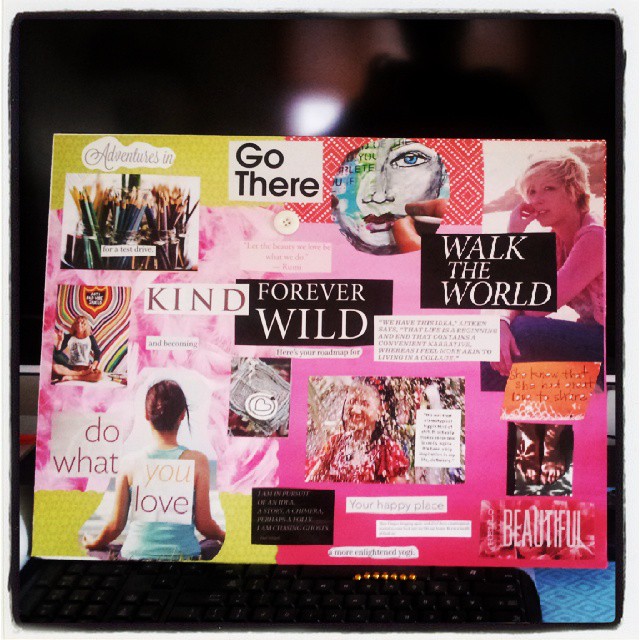
Often we do not know how to confront or meet what is happening. In such situations, I like to turn to my creative skills: journaling, vision boards or dream-mapping, or creating mandalas of natural items found on walks.
Let’s look at the process of creating a dream-map or vision-board. I like to gather images and items starting at the New Moon and put them into a cardboard box—clippings from the news, old photos, and items culled from old magazines, bits of scrapbook papers, letters, cards, poems.
Then on the Full Moon, I settle into a space created for the moment. I set the stage. Spread out a blanket upon the floor. Retrieve the box of gathered treasures, scissors, glue sticks, adhesive, scrapbook paper, with an artist pad or cardboard as a base. I set an intention, say a positive affirmation, and begin the sifting process on what is rising up through these items for me. Often I am surprised that something I had clung to or felt strongly about initially does not make it through the gathering phase for my full moon collage.
Displaying my new vision board is essential, as I do not always recognize the meaning or message in the artwork I created. I like to keep it present and allow for the true messages to come like whispers on the wind, allowing their guidance to become fully realized. I do not need to take action right away. Change is often slow. But having a catalyst to help with the sorting of meaning and story can be extremely enlightening.
Licensed Massage Therapist and Yoga instructor Kim Nixon Hainstock holds a B.S. in English from NMU, has led vision board classes at Ishpeming’s Joy Center, Essentials Massage and Yoga, and with at-risk youth, and is currently navigating change and finding ways to nurture her journey.
Excerpted with permission from the Summer 2020 issue of Health & Happiness U.P. Magazine. Copyright 2020, Empowering Lightworks, LLC.










 Health & Happiness U.P. Magazine