Creative Inspiration: Limit-Busting Community Artist Mary Wright, Christine Saari

community artist Mary Wright, UP holistic wellness publication, UP holistic business
Mary Wright

L’Anse-raised Mary Wright was a homesteader, a teacher of health education, English, history, and art, a cancer survivor, and a feminist. Most people remember her, however, as a community art organizer.

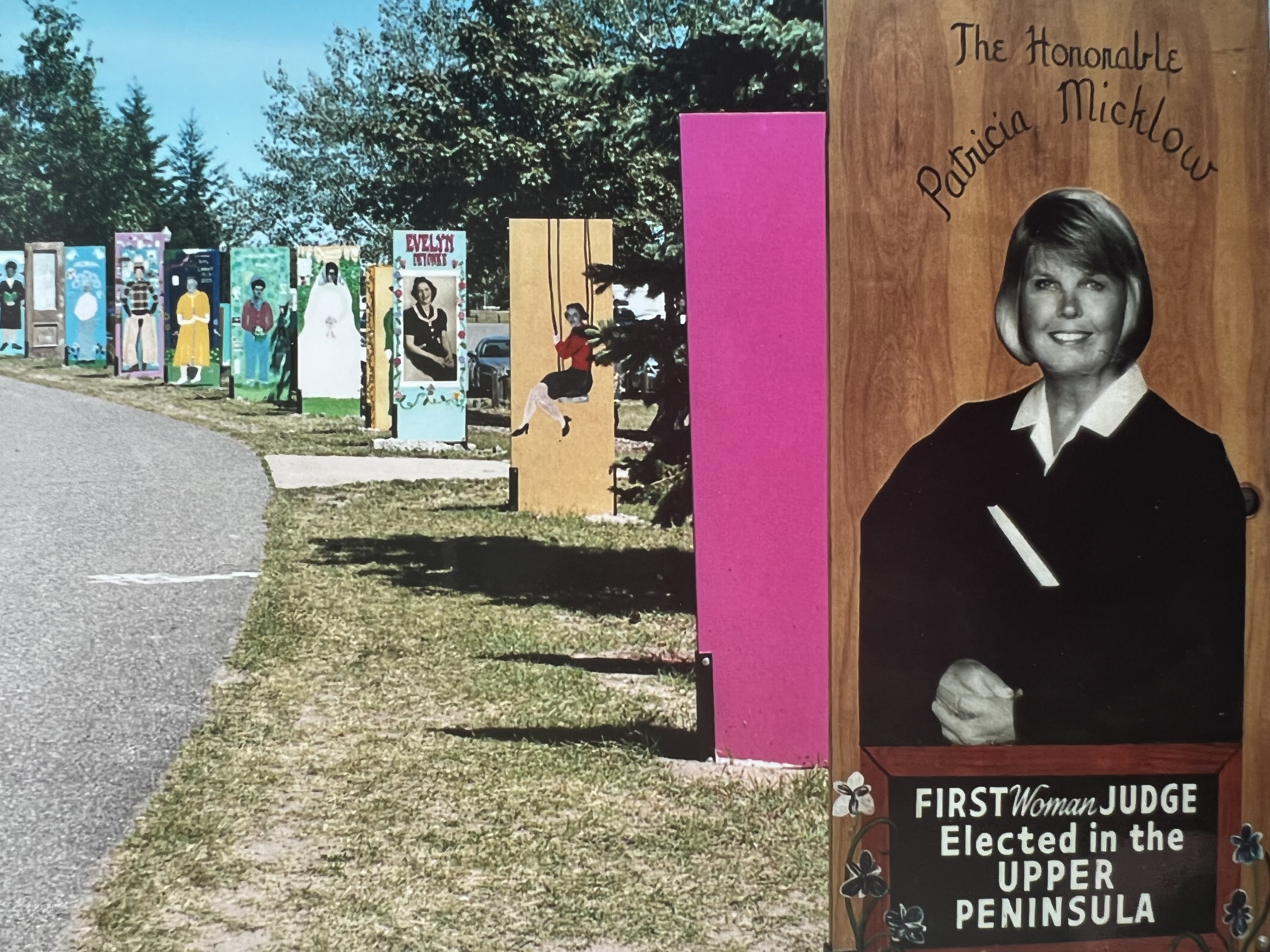
Well over three-thousand blue and white hand-painted chairs brightened NMU’s campus during FinnFestUSA 1996 and 2005. 50 colorful fish shanties appeared at the Lower Harbor parking lot during the World Winter Cities Conference held in Marquette in 1997. Residents painted 400 book covers to represent their city block and raise money for their library. The history of pioneer settlers and families of today were recreated on one of the 500 Heritage Family Poles, set up to celebrate the Marquette Sesquicentennial in 1999. In 2007, 200 doors told the stories of grandmothers, past and current. Over the years, many thousands of people participated in these and other projects, and uncountable locals and tourists viewed them.

When Mary Wright dreamed up these community efforts, the sky was the limit.

No idea was too big or impossible to carry out. Her criteria for any of these undertakings were straightforward: The project had to involve fun, collaboration, and community spirit. Mary believed that every person has the capacity to be creative if provided the opportunity, and that working on joint art projects, reflecting the spirit of old-time barn-raising events, could create miracles.

This community aspect was essential. All participants, from elementary school child to grandmother to prisoner, were welcomed. The wilder the inspiration, the better! If you wanted to cover the wall of your fish shanty with left-over socks gathered at laundromats, or hang shoes of your relatives from your family tree, why not?
Mary Wright Doors Project, community arts, community artist, UP holistic publication, UP holistic business
Mary Wright’s Doors Project

To make these complicated events happen required multiple skills. Mary had a knack for roping people in, persuading them to help paint a mural, create a prototype, drive logs from Munising to Marquette, give money, or procure materials. She networked with local and state art organizations, city government departments, labor unions, and corporations, found donors and sponsors, and worked with the news media. She made countless presentations in schools, clubs, and to any group. And she did it all without a computer or the Internet! Her persuasive powers and persistence were legendary. Mary Wright did not take “no” for an answer.

Mary Wright had a special gift for finding the perfect expression of a particular event:

Blue and White Chairs, Finland’s national colors, were the perfect symbol for FinnFestUSA, an annual international festival held each year in a different city. They gave people of Finnish heritage a chance to honor their families and to define what being Finnish meant to them. They were an expression of hospitality, an invitation to sit down to strike up a conversation, to recycle old furniture, to create an heirloom. All fifteen UP counties participated. Chairs were set up by their painters’ regions, so visitors could find the chairs, benches, stools, and rockers they had decorated. A calendar was later created to provide a lasting souvenir of the event.

Mary felt Fish Shanties symbolized the spunk, spirit, and sisu of UP winter culture. Some grandparents used them to create playhouses for their grandkids. Book Covers were a natural for a library fundraiser. The project was organized around city blocks. This created special pride for residents and helped distribute the covers widely. Family Poles were perfect to portray the 150-year history of Marquette. The many different stories of individual families and organizations told through these poles formed a kaleidoscope of the community’s past and present.

Mary Wright learned how to draw the attention of the news media. Her flamboyant way of dressing in bright exotic costumes, colorful hats, and artful jewelry made her stand out. She managed to get herself on the Today Show in New York, at which she presented a bench decorated with portraits of the show’s luminaries. In the days before drones, she had an aerial photo taken from a helicopter to help advertise her book project. Family poles rode in the Fourth of July Parade. Outdoor working sessions gave visibility to a given project. There were interviews, photographs, and editorials in the newspaper.

community artist Mary Wright, UP holistic wellness publication, UP holistic business

Mary’s unique style is featured in Yoopera, a film documenting the production of the Rockland opera and the creation of Mary’s Storyline project in which thousands of white panels strung on wires fluttered in the wind like layered prayer flags from their spots around the Rosza Center and more Michigan Tech campus areas. Primarily made by schoolchildren, each panel had a photo transfer of someone’s image and the story of that person’s life told in the first person.

Mary Wright’s activities were not restricted to Marquette and Houghton.

She organized over thirty-five community projects, including in places like Alpena, Ypsilanti, and Port Huron, and also worked internationally in Toronto and Finland. Her themes were often based on ordinary objects such as shovels, stepladders, pillow cases, spring flowers, or winter mittens. In 1999, she received Michigan’s Governor’s Award for Arts and Culture.

Participating in one of these community projects has had a lasting impact on many. Often it was the first time someone had created an art object. Mary Wright supporter Doug Hagley said about Family Poles, “Some families were reunited after years of separation. Dialogues were fostered… Children honored their parents and grandparents…. The community and its visitors experienced the healing and community-building power of art.” School children became interested in their family history and realized that you could be an artist at any age. Poet Sandy Bonsall’s experience painting blue and white chairs with her students prompted her to write My Mother’s Story Is My Story. I myself was inspired to create a family pole to explore the Finnish background of my husband, and Grandma Doors led me to research the life of my Bavarian grandmother whom I had never met.

We lost Mary in November 2021. To honor her and her work, the Beaumier Heritage Center at Northern Michigan University will feature her in an exhibit in the spring of 2023. If you are willing to loan Mary Wright project object for the exhibit, please contact Dan Truckey at (906) 227-3212 or email heritage@nmu.edu.

Austrian writer and visual artist Christine Saari has lived in Marquette since 1971. She has published memoir Love and War at Stag Farm (2011) and poetry book Blossoms in the Dark of Winter (2018). Find her visual work at The Gallery and Wintergreen Hills Gallery.

Excerpted from the Fall 2022 issue of Health & Happiness U.P. Magazine. Copyright 2022, Empowering Lightworks, LLC. All rights reserved.

Senior Viewpoint: Evolving from Trauma to Wellness, Beth Jukuri

evolving from trauma to wellness, overcoming sexual abuse, UP holistic wellness publication, UP holistic business

If you were asked to write about health and happiness, what parts of your life would you think about? What parts of yourself would you focus on? 

How would you rate your own health and happiness?

The most sacred part of my wellness is my mind and how much I am able to challenge it. 

 I was indoctrinated into a cult-like religion from birth. I didn’t have access or control of my mind and its beliefs. The religion chose my life for me–where I went, who my friends could be, what I could or couldn’t do with my body.

At forty-six, when a young niece shared with Family Protective Services that “Grandpa touched me,” I became aware that I had been sexually abused as a child by my father.

I also became aware that my body and its emotions and feelings always lived in the truth. My body shook and my steadfastness to stand by my niece and believe her was unshakeable.

My body and its unexpressed emotions, and the way it never lied showed me the fragility of my mind and its false nature.

It became my priority to set my mind right. To bring it back to my body and reality. To use my mind and not let my mind use me.

The wellness of my mind and how it sits with reality is critical in my choice-making and ultimately how I live my life.

Without a mind set in reality, you cannot see life or who you are clearly.

I had lived with so many falsehoods and ill-conceived ideas both of myself and the outside world.

If on your stage of life, you don’t see the backdrop and the other characters in their true form, how will you know how to interact with them?

At forty-six years of age, I woke up in my life and realized I had seen the stage incorrectly and I was playing a part in a play in which I no longer wanted to participate.

The character of who I was fit into the play, but it had no place in reality and with the truth inside of me.

It is ironic to see the darkest parts of your life, to feel the vast emptiness of losing so much and at the same time feel empowered, strong, brave, and deep levels of love.

As I attempted to right my world and to re-adjust the stage, to find the character of me, I brought in new levels of happiness, joy, love, and peace.

I was embracing my history of abuse and acting in the present with new information, and making new choices that honored me.

This did not serve the requirements of my family of origin. It did not serve the silence abuse needed in order to thrive.

I became a new me with a voice and a choice.

The new me brought in new hurdles in many relationships. The open and free relationships welcomed the new me, and we experienced new levels of deep love and connection.

The relationships that were conditional died.

I see this time in my life as one of my greatest achievements—leaving the cycle of abuse.  I changed how I interacted with abuse and that changed the trajectory of my lineage.

My breaking the silence and responding differently than my mother is the most difficult thing I have done, yet became one of the most healthy periods of my life.

I broke out of the family dynamic that supported abuse for generations.

The happiness that has slowly seeped back into my life is pure.

It has no hidden agenda or the false realities such an agenda was based on. Nor is it dependent upon the behaviors of others. My happiness is based on me—how I see myself and my worth, and how I love myself.

The levels of happiness I have found as I walked through decades of denial and recovered my innocence is life-changing.

What I know to be sure is that health and happiness live with truth. They grow and thrive in its presence.

My ability to be myself and to know myself and to love myself all stemmed from my ability to live with dark truths.

As Gloria Steinem once said, “The truth will set you free; but first it will piss you off.”

Even my anger and rage and overwhelming sorrow—after expressed—left me in peace.  I made sense. The world made sense. The truth is so much easier to live with than trying to prop up a false relationship with both myself and others.

I loved me, the broken, twisted me that stumbled out of denial.  I loved her courage and the bravery she showed to admit she didn’t know who she was.

I woke up at forty-six a stranger to myself.

The new me was a stranger in my relationships.

So began the second half of my life living life as Me.

Discovering and choosing what made me happy, what felt like love, where peace lived, and what I felt was true for me became my way of life.

I love this healthier me, one that is filled with so much happiness and knows deep love, even if she is completely estranged from her family. 

I want others to know it is possible to live a good life after abuse.

To be happy.

To know joy.

To feel deep love of self.

What I know to be true is that we love as deeply as we love ourselves.

Abuse isn’t who you are. It is what was done to you. A healthy response is one that honors and respects you.

At sixty-three, I feel very grateful for my mental wellness and the sheer amounts of happiness I experience.  Perhaps it’s because of all the years I lived codependent on others to make me happy that I am now so appreciative of my ability to find happiness alone.

Just being at peace with who I am and the choices I have made, and who that makes me as a person, brings me great happiness.

There are moments in our lives when we have the opportunity to become more ourselves or to find a deeper level of awareness.  These are moments that will define your life either negatively or positively, with more growing or shrinking.

To me, health has always had an evolutionary spin to it—a feeling of growing and changing.  Life is not static.

I feel happiness comes when you are free in the spaces you live and the relationships you have.  The freer you become, the more happiness you gain.

Married thirty-five years, mother of four, grandmother of three, retired mail lady, and fiber artist Beth Jukuri‘s art has become her therapy, her therapy her art. She co-founded WIND (Women in New Directions) to explore oneself and grow more empowered through nature and art.

Excerpted from the Fall 2022 issue of Health & Happiness U.P. Magazine. Copyright 2022, Empowering Lightworks, LLC. All rights reserved.
Co-op Corner: Prescription for Health Program Debuts at 10 Area Farmers Markets

Prescription for Health program, Marquette Food Co-op education & Outreach, UP holistic wellness publication, UP holistic business
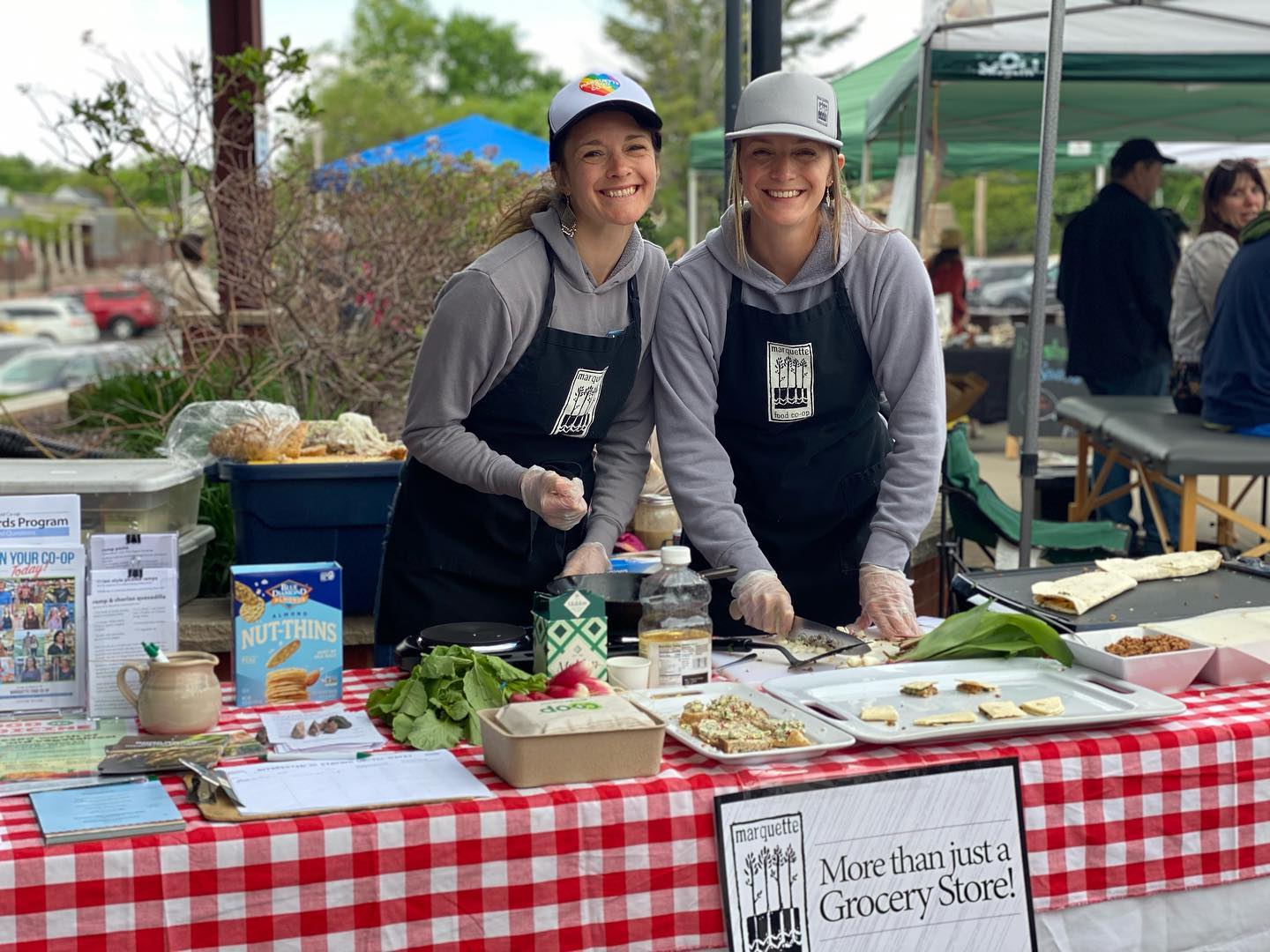
Sarah Monte, MFC Outreach Coordinator & Amanda Latvala, MFC Education Coordinator at the Downtown Marquette Farmers Market

One in 7 people in the U.P. are food insecure. At 14%, the U.P. has a higher food insecurity rate than the national average of 10.5%. Members of the U.P. community whose work is focused on food and health were invited to meet regularly to help direct these efforts. From those meetings, the Food as Medicine Partnership, a collaborative that is bringing Prescription for Health programs to communities across the Upper Peninsula, emerged.

This group, which includes twenty-five organizations, businesses, and individuals, envisions a collaborative food system in the Upper Peninsula that provides nutrition education and equitable access to wholesome, local, and affordable food for all residents. The first project the group took on is a Prescription for Health program, generously funded by the Superior Health Foundation. This Prescription for Health program is unique in that it addresses food access from both the customer and supplier side.

The Prescription for Health program uses a medical referral process for enrollment.

Participants receive a referral from a participating healthcare provider with a prescription for adding fresh fruits and vegetables to their diets. To qualify for the program, individuals must be at risk for or diagnosed with a chronic health condition, face economic barriers to food access, and be 18 years of age or older.

Participants enrolled into the program will receive vouchers to purchase fruits and vegetables from participating local farms. Each participant will receive a total of $15 per week during the 20-week season. The referral process is administered by the Upper Peninsula Commission for Area Progress (UPCAP).

A goal of Food as Medicine and Prescription for Health is to provide these services as widely as possible. The U.P. Food Exchange (UPFE), a collaborative local food network the Co-op helps administer, has members located across the U.P. and active in local food and farmers markets. Members were able to help identify and onboard farmers markets that could participate in the program.

This is more complicated than it sounds, as many markets in the Upper Peninsula are small and lack a market manager. For Prescription for Health to work, the market must have regular produce vendors and a market manager or fiduciary that can be a central contact for the Food as Medicine team to work with.

The current list of farmers markets includes:

Bay Mills/Brimley Farmers Market, Main St. Calumet Farmers Market, Depot Park Farmers & Artisans Market (Ironwood), Houghton Farmers Market, Hancock Tori & Farmers Market, Gladstone Farmers Market, Downtown Marquette Farmers Market, Munising Farmers Market, Newberry Farmers Market, and the Sault Ste. Marie Farmers Market. We hope that more markets can be added as the program continues.

A second focus of the Prescription for Health Program is to ensure that the farms receive support to help them increase the produce available at farmers markets. Farm debt is a huge problem across the country—even small-scale farming requires a high debt burden that is difficult to pay back, especially with an income that varies seasonally. UPFE and the Food as Medicine team want to help alleviate the debt barrier that keeps farms from starting or expanding.

The first ever UPFE mini grant program awarded nine farms $14,000 to increase their cold storage capacity. Funds can be used for the materials and labor to build new or additional facilities, as well as access to technical assistance for construction and HVAC. Grant recipients are also required to work with the U.P. Produce Safety Technician to ensure all the facilities and harvest systems are following best practices.

This funding will support the increase of local food production by ensuring that farms have a place to safely store produce until it can be sold.

Cold storage facilities are also essential for extending the agricultural sales season by providing space for keeping storage crops that can be sold well into the winter, directly supporting the growth of the U.P. farm economy and increasing access to local food for all residents.

This year’s grant recipients include Boersma Family Roots CSA and Farm, North Harvest CSA Farm, and Minnie Farms in the Western U.P.; Snowy Acres, U.P. Gourmet, and Full Plate Farm in the Central U.P., and Jere Farms, Gordon’s Produce, and Dutcher Farm in the Eastern U.P.

This grant program was developed in partnership with UPFE team members that include: The Marquette Food Co-op and the U.P. Food Exchange, Western Upper Peninsula Planning District Region (WUPPDR), Bay Mills College/Waishkey Bay Farm, Fresh Systems LLC, Renegade Sheep, the Marquette County Conservation District/Michigan On-Farm Produce Safety, Portage Health Foundation, and the North Farm/Upper Peninsula Research & Extension Center. Many partners were instrumental in spreading the word about the grant opportunity across the Upper Peninsula. And of course, the Superior Health Foundation funding made this possible.

A collaborative network is essential to make changes in our communities.

To grow our local food system and increase access to healthy food for all residents, we must work together. We offer our thanks to all the UPFE, Food as Medicine, and farm market partners for their work.

To learn more about the Food as Medicine Program, visit upcap.org/program/food-as-medicine or email Sarah at smonte@marquettefood.coop. To become an owner of the Co-op and support future initiatives like Prescription for Health, visit marquettefood.coop/owners/ownership.

*Article provided by the Marquette Food Co-op.

Excerpted from the Fall 2022 issue of Health & Happiness U.P. Magazine. Copyright 2022, Empowering Lightworks, LLC. All rights reserved.

Green Living: Are You a Biophiliac?Steve Waller

biophilia, love of nature, humans as part of nature, UP holistic wellness publication, UP holistic business

Do you crave a quiet weekend at the cabin with a view of the lake or the ocean?

Are you inspired by a mountainous panorama or a garden bursting with colorful flowers and butterflies?

Does a buck deer running through the woods rivet your attention?

Can a short walk outdoors make you feel a lot better?

Is your dog or cat part of your family?

Are you happy that the house plant you’ve tended for years is doing so well?

Then yes, you are a biophiliac.

Erich Fromm (1900-1980), a German social psychologist, originally said biophilia is the “passionate love of life and of all that is alive…whether in a person, a plant, an idea, or a social group.” E. O. Wilson (1929-1921), Pellegrino University Professor, Emeritus, at Harvard University, claimed that “our natural affinity for life―biophilia―is the very essence of our humanity and binds us to all other living species.”

Biophilia is the recognition that you are part of the natural world.

Your ancestors, for hundreds of generations, lived in and depended on the fields and forests. In exchange, they were imprinted with an appreciation of the hazards, bounty, and beauty in wild, spontaneous nature. Sure, they had to struggle through some of nature’s challenges, but afterwards they were rejuvenated by a warm breeze on a summer’s night, a conversation at the campfire, or a cool dip in the lake.

That imprint, passed down from the ancestors, has not diminished. Sometimes it’s hard to recognize in the bustle of modern times, but given an opportunity, the feelings are still there.

Artists, photographers, musicians, all strive to capture the “essence” of nature because it is so appealing. Architects incorporate living plants and bright skylit rooms to make their urban structures feel warm, spacious, airy, and inviting, more like the outdoors. Subconsciously, they acknowledge that most of us are biophiliacs, even if we don’t realize it. When the right nature button is pushed, we get warm and relaxed.

For many, biophilia is the reason we live in the UP.

We want to be closer to nature than to Detroit or Traverse City. We want to meander along a river that runs clear and cold, home to wily brook trout. We don’t want to see human trash or fences. If we lived down south, we couldn’t talk about how we are so tired of winter but love how the trees look after a snowstorm. Biophilia makes us endure the cold so that we can see those lacy white trees once again.

Birds come in a dazzling array of colors, yet none of the colors ever clash. All birds’ colors go together. Is it because the birds are just snappy fashion-smart feather-dressers? Or is it because our sense of color and what goes with it is based on what humans have experienced in nature for thousands of years? Biophilia likely shapes our sense of color, beauty, and art.

That sense of beauty even extends to our preferences in partners. When we say someone is beautiful or handsome, is it because we are drawn to a certain brand of makeup or shirt, or are we drawn to the person beneath all that dressing? Our ancestors evolved this crazy habit of choosing partners that they found attractive and passed that imprint on to us. Biophilia shapes our preferences.

You might discount this ancient influence and think your modern choices are beyond primal inheritance. You might think it is all just a nostalgic excuse for common and conventional thought. But it’s not. It’s art. It’s beauty. It’s natural. You’re a biophiliac.

Steve Waller’s family lives in a wind- and solar-powered home. He has been involved with conservation and energy issues since the 1970s and frequently teaches about energy. Steve can be reached at Steve@UPWallers.net.

Excerpted from the Summer 2022 issue of Health & Happiness U.P. Magazine. Copyright 2022, Empowering Lightworks, LLC. All rights reserved.

Bodies in Motion: Moving Your Body & Perceptions to a New State of Wellness, Mohey Mowafy

weight bias, movement for health, healthy perspective on weight, physical fitness, UP holistic wellness publication, UP holistic business

We may or may not admit it, but we tend to judge people based on their appearance, particularly their body weight/size. Well, there is nothing in any appearance that should be used singularly to determine one’s health.

Back in 1975, I began developing a short, two-credit class about obesity. It was held on summer weekends at a camp that Northern Michigan University owned at the time. The paradigm I developed and taught turned out to be embarrassingly erroneous. Admittedly, I had fallen into the misperception that “if one is fat, everything is wrong about that one.”

A common bias that exists is to judge the entire personality of another human by their body weight, pretending we are simply worried about their health. Worse is the agonizing psychological pain that the overweight person must endure, believing it is all their fault. Admittedly, this is practiced far more fiercely against females than it is against males.

Fast forward to 1978, when I was attending a conference on the subject of obesity and eating disorders. One day, I wandered inside a room where the presenter’s talk convinced me that I had been wrong for so long. Her presentation stopped me dead in my tracks. I felt like I was perceiving the world through a new pair of soul lenses.

She was introducing a brand-new concept—that of “Health at Every Size,” a term later trademarked by the Association for Size Diversity and Health in 2003. Health at Every Size (HAES) opposes the idea that a person’s body weight and size is an accurate, full-picture representation of their health status. Naturally, I formed the NMU student organization “Good Health for All Sizes.” Yup, got the T-shirt to prove it! The concept rests on an enlightened assumption: A person’s health is much more nuanced than one single calculation.

Because we all have an internalized weight bias (applying negative stereotypes to ourselves and/or others),….

….ask yourself what “kind” of images of people you see in ads, on billboards, and in most of our films and series. Large folks are never portrayed as desirable. Yes, we have been doing better more recently. But how many people do you know who dismiss generous-size folks as far less than “okay”? Most of us believe that those who do not fit the “ideal” image have only themselves to blame because they must be lazy and gluttonous. Well, this might be true of some, but I assure you, not all. No wonder those with large sizes also adopt such a devastating belief! I was an obese child; I know.

Think of someone you know who has struggled with her/his weight all of their life, then ask yourself this question: Why is it that every time they starve themselves on a diet, they gain all the weight back plus a little more? Heaven knows, I tried to convince my sisters not to follow the unenlightened crowds, to no avail.

In my classes, or in any presentation to any group about this subject, I use a moment from the movie Gone with the Wind. When Scarlett went back to Tara, hungry and with no food in the mansion, she had to dig a potato from the ground. She swore “As God is my witness, I shall never be hungry again.” That is what our body tells us when we starve it. My stock answer when anyone asks me about a diet they want to follow to lose weight is this—“if you can live on it the rest of your life, go for it.”

So, if going on a diet is something we always do but it always fails us, or we fail it (96% of those who attempt to lose weight by “going on a diet” regain it, plus a few more pounds), consider a new possibility. The answer will not sound “conventional” to you, I am afraid. Try this to liberate your mind by considering a far more realistic paradigm to be healthy and yes, spunky. I have always asked my students to add to the list of health measurements one that I call “spunk.” Well, academically, it is called “activity.” It simply requires muscle movement, which the muscles were born to love. Seriously, when we are reasonably active, our muscles not only work, they work better, and they just love it! Science has shown that our muscles do not just move us around; they are also potent metabolic regulators on a cellular and sub-cellular level.

Moving our muscles need not be called exercise.

It’s okay if the word doesn’t frighten you. But if it does, just don’t call it anything. Moving need not be a chore and certainly oes not dictate a gym membership. My personal favorite now (or perhaps I should add, at my age), is walking. Yes, just walking. Ask those who walk. They not only feel alive, they have a special relationship with themselves (including their emotional/psychological/spiritual selves).

How about just dancing, even when no one is watching? It is much more fun when we act silly on purpose. And, how about finding some simple movements that you can do at home even while you are sitting if you need to? The idea of “use it or lose it” may apply very well here.

Finally, I would like to clarify that I am not advocating obesity if it is not a person’s normal state. Yes, it can be helpful to calculate Body Mass Index and waist size as a measurement of general health. But how we go about “fixing” it needs to become more enlightened than what has been typical so far.

Mohey Mowafy is a retired Northern Michigan University Professor. He graduated from the University Wisconsin (Graduate work at the Muscle Biology Institute and the Biochemistry Departments). He is married to Kristen Mowafy, and is the father of Adam Mowafy.

Excerpted from the Summer 2022 issue of Health & Happiness U.P. Magazine. Copyright 2022, Empowering Lightworks, LLC. All rights reserved.

Healthy Cooking: The Art of Blueberry Pie, Val Wilson

There is nothing as sweet as wild blueberries picked fresh in the UP! The challenging part is not eating all of them as you pick so you still have enough to make a pie. The beautiful flakey crust and rich blue color can make that pie look like a work of art!


There are many health benefits in these little sweet berries. Blueberries are full of antioxidants, which are important for getting rid of free radicals in our bodies that can cause disease. What gives those beautiful blueberries their blue color is the antioxidant anthocyanins which studies have shown can help prevent neuronal diseases, cardiovascular illness, cancers, diabetes, and other inflammatory diseases. 


Containing vitamin K, iron, calcium, and zinc, blueberries are good for your bones. They also contain vitamins C, A, E, magnesium, folate, manganese, and beta carotene, and are high in fiber and protein. Plus research has shown consuming blueberries can help increase the rate of muscle strength recovery and muscle repair if you suffer from exercise induced muscle damage (EMID). And the wild berries are reported to have more of the healthy antioxidants and, in my opinion, more sweetness. 


In the following recipe I use whole grain flour. I prefer spelt or kamut flour. If you want to create a gluten-free crust, I would suggest using oat flour. Any flour will work to create the crust for this recipe. 


Blueberry Pie*

Crust 
3 cups whole grain flour 
1/2 cup olive oil 
1/2 cup water 
Pinch of sea salt 

 
Filling 
5 cups blueberries 
1/2 cup brown rice syrup 
2 T. lemon juice 
5 T. arrowroot 
1 tsp. cinnamon 

To make the crust, mix together all the ingredients until you get a firm dough that will hold together. Divide into two equal parts, form into round discs, and cover in plastic wrap. Put in the refrigerator for a couple of hours, then roll out the crust between two pieces of plastic wrap and put in an oiled pie pan.

For the filling, put all of the ingredients in a sauce pan, then cover and heat on low. Once the filling starts to heat up, the blueberries will release their natural juices. Once this occurs, mix everything together. As it heats, the arrowroot will thicken the filling.

Pour filling into bottom crust. Roll out the top crust in the same way as the bottom crust. Place the top crust over the pie and pinch the edges to create a decorative edge. Bake at 350 degrees or one hour. Let cool before cutting.


*Recipe from Chef Val’s new cookbook Simply Healthy Scrumptious Desserts

Chef Valerie Wilson has been teaching cooking classes since 1997. She offers weekly, virtual cooking classes that all can attend. Visit http://www.macroval.com for schedule, cookbook purchases, phone consultations, or radio show, and follow her on Facebook at Macro Val Food.

Excerpted from the Summer 2022 issue of Health & Happiness U.P. Magazine. Copyright 2022, Empowering Lightworks, LLC. All rights reserved.
Positive Parenting: Planning a Family-Friendly Food Forest, Aster Michelsen

family-friendly activities, positive parenting, planning a food forest with your kids, UP holistic business, UP holistic wellness publication

Think back to the last time you relaxed or played in nature. The calming presence of trees… the rich aroma of earth…the invigorating tickle of sand or grass on your feet.

As with the arts, nature immersion provides a healing experience for mind, body, and spirit. You may even agree that it’s an essential element in the art of life!

While time outdoors is good for everyone, the benefits for children are especially compelling. Hundreds of studies show that spending time in nature is essential for their development, including helping them develop:

  • A stronger immune system
  • Improved cognitive development
  • Better memory and attentiveness
  • Lower risk of myopia
  • Lower stress hormones
  • And many more benefits

Sadly, children are spending less time outdoors in nature than ever before. And it’s taking its toll in skyrocketing levels of childhood obesity, attention difficulties, depression, and other physical and mental disorders.

A Natural Solution

Most parents don’t intentionally separate kids from nature. It’s a byproduct of the world we live in. Gone are the days when parents could safely let their kids roam the neighborhood unsupervised. And with most parents now working full time, it can be tricky to find time for a daily nature walk between juggling work, school, after-school activities, and life in general. Fortunately, there’s a very simple (and delightful) solution: plant a food forest in your backyard!

What Is a Food Forest?

Permaculture food forests, or forest gardens, are becoming the next big trend in landscape design. The concept is simple: an attractive woodsy garden that provides an abundance of food right in your backyard. Food forest design aims to mimic the beauty and feel of a natural woodland area—with the added benefit of providing fresh, healthy, delicious food for your family. For kids, this can be life changing.

Why Plant a Food Forest for Your Family?

Food forests provide nourishment for mind, body, and spirit. The three main benefits of a backyard forest garden are:

Clean, healthy food: Perennial plants such as berry bushes, hazelnut shrubs, and fruit trees produce a yield of uber-fresh produce year after year without toxic sprays or intensive labor.

Low-maintenance beauty: Just as traditional landscaping beautifies a space, so do forest gardens. Food forests often include flowering plants, shrubs, and trees that attract essential pollinators such as butterflies. It’s food for the eyes!

Sanctuary space: Forest gardens provide a safe environment for the whole family to play, relax, and gather. Plus, unlike a hike in the woods, you don’t have to worry about getting lost!

Kid-Friendly Food Forest Design Tips

Mindful planning helps ensure that your food forest meets the needs of both plants and people! Planning a food forest with children in mind can be a lot of fun. But there are a few things to think about that adults might overlook.

Safety


We can’t talk about family friendly food forests without touching on safety. This can become a bit of a gray area because each child has different needs. For example, incorporating a pond may work well for older children, but can pose a drowning risk to babies and toddlers.

One safety element that stands out for all ages is a fence. Adding a fence around your forest garden gives children a clear boundary and helps them feel confident that they are safe within the garden space. It’s also a great support for climbing vines such as arctic kiwis, pole beans, or grapes!

Another important consideration is plant toxicity. Some food plants, such as rhubarb, may have toxic parts. Use your discretion and either avoid these plants or take care to teach your children respect for them.

Incorporate the Senses

Kids are meant to interact with the world around them. A food forest gives them every opportunity!

When planning your forest garden:

  • Think about fall and spring color as well as different visual textures.
  • Incorporate the wonderful aromas of many herbs and flowers. Kids love them!
  • Add wind chimes or bird-attracting plants to create a musical garden.

Because all the plants in a food forest are edible, children can also explore taste in a safe way. A food forest garden is also the perfect place for sensory play. Consider adding sensory materials for children to play with, such as sand and potting soil. You may be surprised at all the creative things kids will do with earth, flowers, twigs, and seeds as inspiration!

Sanctuary Space for Kids

Sanctuary space for adults may look like a space for mindful meditation or hanging out with friends, but children’s sanctuary needs can look quite different.

Incorporating structures for hiding and/or climbing can make children feel more at home. This could be a temporary structure like a sunflower house, or a more permanent space such as a treehouse or a clearing inside a circle of shrubs. Or, help them create a fairy garden or a little playhouse for their dolls or trucks tucked under the leaves.

As Children Grow


As kids grow up, their needs change. A five-year-old may love making mud pies, but a teenager? Probably not. When planning a backyard food forest, consider not just your family’s needs in the moment, but also five or ten years down the road.

One of the best ways to do this is to involve the whole family in the planning process. And if you have a family friend who is a few years older than your own children, consider consulting them too!

Planning Your Family Friendly Food Forest

A well-thought-out food forest plan, or blueprint, can make the essential difference between a bunch of plants thrown in the ground and a beautiful, practical forest garden that will provide maximum enjoyment and yield for your family for years to come.

Consulting with a certified permaculture designer can be a valuable investment in ensuring your food forest benefits your family in the best ways possible. But whether you purchase a blueprint design or dig in and do it yourself, don’t forget to include your kids in the planning. Kids are natural artists. You may be amazed at the creativity they bring to your backyard food forest garden!

Aster Michelsen is co-owner of Great Lakes Food Forest Abundance, an Upper Peninsula edible landscaping company. For more information about UP food forests, edible landscape, and building resilient human and natural communities through gardening, visit us at GreatLakesFFA.com.

Excerpted from the Summer 2022 issue of Health & Happiness U.P. Magazine. Copyright 2022, Empowering Lightworks, LLC. All rights reserved.
Healthy Cooking: Millet Sweet Potato Savory Biscuits, Val Wilson

Healthy Cooking, Millet Sweet Potato Savory Biscuits, gluten-free holiday treat, UP holistic business, U.P. wellness publication, Upper Peninsula of MI holistic wellness publication

During the cold winter months, warm baked goods are always satisfying. And since you may not always be in the mood for baked goods that are sweet, here is a savory, more dense, hearty biscuit recipe. These biscuits are great to serve with your dinner, plus make a great between-meals snack when you get a little hungry.

Millet is one of the oldest whole grains, and has been eaten since at least 2800 B.C. Very high in protein, iron, calcium, and B vitamins, millet is gluten-free and the easiest whole grain to digest. Known for helping to strengthen your spleen, pancreas, and stomach, it is great for anyone with digestive issues. Millet has a creamy texture, making it perfect to create baked goods such as these biscuits. 

Sweet potatoes are native to South America and were domesticated at least five-thousand years ago. The crop must have been an important one for our ancient ancestors because ancient pottery has been found to feature sweet potato images. Sweet potatoes have vitamin D for healthy bones, vitamin C, B 2, B 5, and manganese. They’re also exceptionally high in iron, calcium, and potassium, making sweet potato an excellent food for your heart. Plus, they help boost your immune system, contain antioxidants, and help strengthen your kidneys. In this recipe, the sweet potato creates a mildly sweet flavor that is sure to satisfy your taste buds. 

Millet Sweet Potato Savory Biscuits 

1/2 cup millet 
1 cup water 
3/4 cup rice beverage (non dairy beverage) 
2 cups sweet potato (peeled and cut in cubes) 
1/4 cup olive oil 
1/4 cup rice beverage (non dairy beverage) 
1 tsp. sage 
1/2 tsp. rosemary 
1/4 tsp. sea salt 
2 cups oat flour 
1/2 cup medium corn meal 
2 tsp baking powder

Put the millet and one cup of water in a pot and bring to a boil for a minute. Reduce heat to lowest possible temperature, cover and simmer for 20 minutes until all water has been absorbed and millet is soft. Remove from heat and let sit 5 minutes. Add the 3/4 cup rice beverage to the cooked millet and let it sit covered while you prepare the rest of the recipe. Steam the cubes of sweet potato until soft. Put the olive oil, 1/4 cup rice beverage, sage, rosemary, sea salt, and steamed sweet potato in a food processor and puree until smooth. Put the oat flour, corn meal, and baking powder in a mixing bowl, add the pureed mixture, and mix all together until you get a firm, thick, muffin dough texture. Using an oiled muffin pan, spoon the dough onto the pan into 12 muffin-size biscuits. Bake at 350 degrees for 30 minutes until golden brown on the bottom. Eat them warm out of the oven or at room temperature after they have cooled down. 

Chef Valerie Wilson has been teaching cooking classes since 1997. Visit http://www.macroval.com for schedule, cookbook purchases, phone consultations, or radio show, and follow her on Facebook at Macro Val Food.

Excerpted from the Winter 2021-22 issue of Health & Happiness U.P. Magazine. Copyright 2021, Empowering Lightworks, LLC. All rights reserved.

Green Living: Make Your Airfare “Air-Fair,” Steve Waller

flying green, Green Living, UP Holistic business, U.P. wellness publication, Upper Peninsula of MI holistic publication

“You are now free to move about the country.” We love to fly, and it shows. Airports and airplanes are crowded. It’s finally affordable and possible to just jump on an airplane and “fly the friendly skies” to grandma and the distant kids for a long-awaited holiday hug. “You deserve a break today” in some warm exotic place. Leave COVID confinement a thousand miles behind. What takes days by car is just a couple of hours away by plane. The power and roar of a jet engine taking off is a sign of “something special in the air”—massive amounts of carbon dioxide, CO2.

But you can fly green. I’ll explain.

A single weekend flight, Detroit to Los Angeles, four thousand air miles round trip, emits more CO2 per passenger seat than the average American car emits in three months. Automobiles with two passengers produce only half the CO2 per person. But airplane miles and CO2 are rated per seat. Two passengers generate 8,000 miles of airplane CO2 instead of 4,000. If you and another fly to Los Angeles, that rate comes to the equivalent of almost seven months of automobile CO2 in a weekend!

Jet fuel, aviation gas, and automobile gas each emit almost twenty pounds of CO2 per gallon. On average, an airplane produces over fifty-three pounds of CO2 per air mile. A 747 airplane can carry up to 568 people and 63,000 gallons of fossil fuel. It burns about 5 gallons of fuel per mile, about 1 gallon per second! That 4,000 mile flight generates (4,000 miles x 53 lbs. CO2 per mile) 212,000 lbs.—100 tons of CO2! In 2019, the average domestic commercial flight emitted 0.39 pounds of CO2 per passenger mile. 4,000 miles x 0.39 CO2 per mile = 1,560 lbs. CO2 per person.

Today, globally, there are more than 100,000 flights per day.

Global airline passengers are expected to double in the next 20 years. Improving fuel efficiency (proudly claimed by many airlines) reduces emissions 1% per year but flights are increasing 6% per year. It’s not even close. Airline CO2 is rising.

Some airlines promise “Sustainable Aviation Fuel” (SAF – biofuels) but hardly any is available. One popular airline boldly committed to replacing 10% of fossil jet fuel with SAFs by 2030 (90% will still be fossil fuel).

Fly greener. Compensate for airline emissions by buying carbon offsets. Offsets try to neutralize airplane CO2 by preventing or removing equivalent CO2 elsewhere. However, it is hard to be sure an offset will permanently “absorb” the emissions your flight generates.

Some offsets plant trees to capture CO2, but seedlings take 20 years to grow big enough to be effective. If seedlings or trees die or are cut down or burn in a wildfire within the next 200 years, the CO2 returns to the air. Instead of planting trees, we must focus on growing and protecting trees, especially the biggest and longest-lived trees, for centuries.

Some offsets support social programs in poor countries that build schools to educate people about carbon solutions and sustainability. They build roads and ranger stations to help prevent illegal logging or provide more efficient cookstoves so very poor families burn less wood for cooking or use less fossil energy. My favorite offsets support methane capture or solar and wind energy projects which directly prevent CO2.

You choose how your offset dollars are used. Average offset prices are between $3-$50 per ton of CO2. Some people annually offset all their CO2. Consider the United Nation’s Gold Standard certification (https://marketplace.goldstandard.org/collections/projects or https://clear.eco/).

Steve Waller’s family lives in a wind- and solar-powered home. He has been involved with conservation and energy issues since the 1970s and frequently teaches about energy. Steve can be reached at Steve@UPWallers.net.

Excerpted from the Winter 2021-22 issue of Health & Happiness U.P. Magazine. Copyright 2021, Empowering Lightworks, LLC. All rights reserved.