Blog

Inner Nutrition: Friendships, Social Media & Authenticity by Crystal Stone

The importance of friendships is emphasized and promoted in our culture and social media, and is generally accepted as a necessary part of mental health and wellness. Indeed, the importance of friendships to support mental health has been well researched, supported, and reported (check out http://www.mayoclinic.org for more information). Many different kinds of friendships and levels of depth can be formed, depending upon the people involved and other contributing factors.

But what happens when a friendship runs awry? Or when a friendship that was supportive no longer seems to be? I’d like to dispel the myth that all friendships should be easy and require little-to-no effort to maintain, making it taboo to talk about when friendships struggle or tank. Friendship difficulties can become a shameful secret a person may harbor, perhaps similar to getting divorced from a spouse or estranged from a child.

Despite the positive value of social media, it is set up to champion “likes,” which automatically promotes those ideas popularly accepted by the culture, which may not be helpful in the long run. In return, an individual’s post may become buried despite its validity or relevance. This can lead people who may have helpful ideas contrary to the social norm to be invalidated by the very social system from which they are seeking support.

I enjoy and can see the appeal of social media, but it is not without its faults. For folks who have blurry boundaries, lack protections, and are still forming their conclusions about the world, social media can bolster psychological binds that are difficult for the uninitiated to recognize. For example I recently saw a very popular (22K likes) quote – “You’ll know the people that feed your Soul… because you’ll feel good after spending time with them.” Taken at face-value, I would agree, and I get a warm, fuzzy feeling about it. But let’s also take a critical look at how this contributes to the myth that friendships should be easy. Having challenging conversations typically does not feel good for people-pleasing or conflict-avoidant types, but this may be necessary in order to grow together. It may be worth spending time not feeling “good” for a while to talk (so long as it’s emotionally and physically safe!) about feelings, needs and other vulnerabilities. This is one important way emotional closeness is built. It may not be comfortable, but in healthy, reciprocal relationships, it is worth it.

The topic of friendships has always been a bit of a sore spot for me. There were times in my elementary school years when I was bullied for months. At other times, I was ostracized from my friendship group for reasons I found out later were unfair and the product of further bullying tactics. Those experiences, coupled with my natural shyness and sensitivity to the world, caused me to be extra vigilant for mean behaviors in others.

In order to cope with being bullied, I developed a way of putting other people first in friendships as I found this led to their being less likely to turn on me. I thought that if I treated them as more important than me, they might like me more. Even though I seemed to have some success with this strategy as a kid (and it strengthened my helping nature in the long run), as an adult I have come to value reciprocity and mutuality in friendships far more than simply staving off rejection by sacrificing myself to be liked. Nonetheless, learning that lesson meant I had to question many of the pithy, yet inspiring ideas our culture has about making and keeping friends.

Months ago, I experienced a falling-out with a friend. We had an argument (several, actually). Despite my best efforts to demonstrate understanding for her point of view, I couldn’t seem to elicit the same from her. The more excited I got about getting her to understand my perspective, the more she recoiled and hunkered down in her position. My patience and caring for her dried up in response to her extinguishment of the process. I felt shut down and dropped; she wasn’t being fair! Months passed with no further discussion. Life went on, but my feelings were hurt, and I grieved the loss.

I recognized this incident as an important growth experience. Moving forward, I embraced it and dove deep into understanding myself and what happened with a spirit of love and self-respect. I spent time nurturing other friendships and enjoyed a variety of social situations. I found an author (Ross Rosenberg, The Human Magnet Syndrome) who helped explain relationship dynamics in an interesting and constructive way that I found empowering and freeing when applied to myself. I cultivated my rich inner experience to be full of self-care, self-understanding, and empathy for others who have had experiences similar to mine.

The friend in question and I met recently in order to talk… and it went okay. We took turns talking, and we both seemed genuinely interested in what the other was saying. We’re not close the way we were before, and we’re not sure that this friendship will go in that direction. And however the friendship goes, it’s okay. Friendship may be a benefit in life, but if a particular friendship doesn’t last or remain as close, it doesn’t mean you’ve failed big time. Friendship is a type of agreement between two people. Life is not static, so such an agreement may naturally require change, bringing more or less closeness. Either way, it still holds value. As with most things, you can learn from any friendship in order to grow into a more authentic, engaged, and fulfilled version of you.

Crystal Stone, LMSW, CAADC is a mental health therapist in the Houghton/Hancock area. She specializes in trauma recovery and EMDR therapy. You can reach her at tamarack.healing.arts@gmail.com and check out her website: tamarackhealingarts.com.

Excerpted with permission from Health & Happiness U.P. Magazine, Fall 2018 Issue, copyright 2018. All rights reserved.

A Senior’s Viewpoint: Women’s Rights through the Years by Karlyn Rapport

Our parents worked to make things better for the next generation. Are we?

In the late ’60s, Betty Friedan’s book The Feminine Mystique raised awareness of inequities women face. At that time in Marquette, women could not have a library card, a credit card, or a loan in their name.

Changes have occurred, but women do not have equal rights. The 14th Amendment of the Constitution states men are guaranteed equality under the law. Women are not included. The Equal Rights Amendment (ERA) says:” Equality under the law shall not be denied or abridged by the United States or by any state on account of sex.” Congress overwhelmingly approved ERA on March 22, 1972. Thirty-five of the needed thirty-eight states ratified this amendment, but we were unable to obtain the needed three states by the 1982 deadline.

Recently, Nevada and Illinois ratified ERA. A third state is likely to follow. Congress needs to pass legislation extending the deadline, recognizing the ratification of three additional states. It is unlikely this Congress will do so. In view of hard-fought gains, is it necessary? The ERA would clarify for all that sex discrimination in employment, reproductive rights, insurance, Social Security, education, and more is a violation of our constitutional rights as Americans. Legislation, court victories, and presidential executive orders against sex discrimination are not permanent. The ERA places the burden of proof on those discriminating instead of those fighting for equality. Now men have rights, but women have to prove they have rights.

In the ’50s, women could be teachers, secretaries, clerks, waitresses, and nurses. I was the first teacher in the Ishpeming school system allowed to teach while pregnant. The fact that I was one of three speech pathologists in the U.P and Ishpeming was sorely in need of my services helped. Now women can enter any field. However, women are confronted by a glass ceiling, a gender pay gap, a motherhood penalty, and worse. Pay inequity is a loss of family income. Each diminished paycheck affects future Social Security and retirement income as well. The 2012 Census revealed 17.8 million women or 1:7 live in poverty; low-paying jobs, lack of access to reproductive healthcare, and unaffordable child care trap them.

The Affordable Care Act allowed access to contraception, reducing the number of unintended pregnancies and abortions. These rights are in jeopardy. Access to reproductive health care is sex discrimination. Women and only women are denied control of their reproductive lives. Roe vs. Wade is under threat by a conservative Supreme Court. A woman’s financial security and her right to make the decision whether or when to parent a child is in jeopardy. In 1959, a dear friend suffered tragic losses of her husband and 3-year-old daughter due to carbon monoxide. She miraculously survived. She was 6 weeks pregnant. Two obstetricians and a psychiatrist recommended termination of the pregnancy, but the University of Michigan Hospital would not perform this medical procedure. I travelled with her to New York, where she paid a prosecuting attorney to protect herself from being charged with a crime. I know of others who died as result of illegal abortions. Recently an Arizona woman tried to have her physician’s prescription for an abortifacient filled because the fetus she was carrying died in utero. The pharmacist would not fill it. States have adopted 833 measures restricting women’s reproductive rights since 1995.

Violence against women remains pervasive. There are 1.3 million women victims of physical assault reported yearly. The National Coalition Against Domestic Violence estimates this is one quarter of the actual numbers. One in 6 women have been victims of attempted or completed rape.

In the late ’60s, a serial rapist attacked women on the bike path in Marquette. Houses posted red signs in their window indicating this was a place to run for safety. The perpetrator was eventually apprehended. The Women’s Center developed a team of trained advocates to assist women through the process of dealing with this trauma. The hospital began using forensic rape kits. The Women’s Center continues to offer support for survivors of sexual violence.

As a speech pathologist at MGH, I treated several patients who suffered traumatic brain injury as a result of domestic violence. Family members were afraid to provide shelter fearing reprisal by the assailant.

Members of the Marquette Branch of AAUW assisted me in bringing a Spouse Abuse Task Force together of people and agencies trying to help survivors of domestic violence. The Women’s Center, law enforcement, and the prosecuting attorney’s office were at that table. The Spouse Abuse Shelter, now Harbor House, is a product of this task force. The Women’s Center, its Harbor House program, and the Blue Print for Safety Program through the Prosecutor’s Office continue to assist survivors in rebuilding their lives and are focusing efforts to hold the perpetrator accountable.

The Violence Against Women Act (VAWA) is up for reauthorization. This legislation addresses domestic violence, sexual assault, stalking and dating violence. VAWA supports and funds essential services for survivors and their families. This bill improves health care responses, and provides housing protections crucial to improving safety when survivors flee abuse. Domestic violence is a leading cause of homelessness for women and their children. Urge legislators to co-sponsor this legislation and adequately fund it.

The Me Too movement gives me hope. Sexual harassment and violence persist. Now some perpetrators face consequences. Will such egregious behavior be tolerated?

The Equal Rights Amendment could provide remediation. All need to work for equality for all. Will we continue to allow women to be treated as second class citizens? My advice: Do research. Learn what the job is worth. Learn to negotiate an equitable wage. Work for ERA. Above all, vote on November 6 as if your life and the lives of your children and grandchildren depend on it because, in fact, they do.

Karlyn Rapport, founding mother of the Women’s Center’s Harbor House, is the Public Policy Representative for the Marquette Branch of AAUW and Michigan AAUW’s Public Policy Committee. She was Marquette County Commissioner for 6 years and is currently on Marquette County’s Board of Health.

Excerpted with permission from Health & Happiness U.P. Magazine, Fall 2018 Issue, copyright 2018. All rights reserved.
Bodies in Motion: Dead River Derby, by Amber Kinonen

DRD

A muscled shoulder barrels into my chest, reeling me backwards. My butt smacks and then slides across the concrete surface. I scramble to my feet, but the same sweat-glistened shoulder flashes toward me again. I spin away only to have another opponent send me to the floor once more. However, I don’t give up. Instead, I think to myself, “Challenge accepted!” and rise. Even though this may sound like something from an MMA (Mixed Martial Arts) match, it captures less than ten seconds of a roller derby bout.

In 2012, I was invited to skate for Marquette’s Dead River Derby, also known as “DRD.” At first, I was surprised by the perception of derby girls: They are tough, wear booty shorts with ripped up stockings, throw elbows and fists, and have tattoos. As a teacher, scout leader, and mother of two, I was not sure I would fit in. Now, years later, I know that roller derby is no longer the banked track where women dramatically throw each other around. There is an abundance of contact; however, athleticism, strategy, and safety are valued. In fact, derby is one of the fastest growing sports for women with more than 1,200 leagues worldwide and attempts being made for it to qualify as an Olympic event. Why are so many choosing to play?

First are the reasons not to play. One is time. Derby requires hours of drills on skates to avoid injury, the complex gameplay takes practice to understand, and a league’s existence depends on members’ volunteerism. Another issue is money. Derby can be expensive as lots of gear is required for safety. Finally, injuries occur. Derby carries the same risks as other contact sports such as football and hockey.

However, there are also many benefits to playing. The most obvious is exercise. Practices are demanding with a mixture of stretching, footwork, endurance drills, core body exercises, and strategy skills. Therefore, many parts of the body are strengthened. A lot is done in a short amount of time, but the variation and support from teammates makes it not only bearable but enjoyable. In fact, I have to force myself to exercise on a bike or treadmill, but I eagerly burn calories on my skates for hours at a time. When I miss practice, my body feels it, and when I finish practice, my body is strong.

Other benefits are not so obvious. Derby allows a range of women to be involved. Some are thin and others curvy. Round booties can stop jammers, tiny ones can evade blockers, and anyone can choose to participate in a league. Women of varying ages can also participate. For example, the average age of skaters in the DRD is forty-three, which is higher than many other leagues. Backgrounds are also wide-ranging. Membership consists of teachers, business owners, accountants, college students, and stay-at-home moms. There is a place for anyone with determination. As we work to become an effective team, the diversity provided by derby fosters comradery unlike any experienced elsewhere.

Derby also requires the brain to work in ways a person may not be used to. I equate it to a game of fast-paced chess with contact. A skater must think critically and quickly. Skaters have to make gameplay happen in a matter of seconds to gain advantage over the other team. The track can be confusing because so much is happening; calculating and executing strategy requires awareness, mental strength, and focus.

Another benefit is a sense of accomplishment. When I first started, I couldn’t stand on my skates. Every training session was a challenge, but if I could race around the track a little faster or jump higher than the week before, I felt good. Now, I’m trying to jump the apex or pull off a pummel horse. I still leave practice awed by what my forty-one-year-old body is capable of accomplishing.

In addition, most people think that being tough indicates a lack of fear. However, derby has taught me that being tough means being afraid but doing what scares you anyway. It is a sport where even after years of practice, my fear of failure and injury is still there. Nevertheless, I skate. When a game is over, regardless of performance, I am satisfied that even though I may have been so nervous I gave myself a fever beforehand, I got on the track and worked my hardest.

Derby is not about a bunch of rogues who throw theatrical punches on the track. It is so much more. My children get to watch their mom, an athlete, working with an eclectic group of women as part of a team. They see hard work and determination from a mom who gets knocked down but, most importantly, gets back up, over and over again.

Amber Kinonen skates under the name of “Ripper” for Marquette’s Dead River Derby. She has been skating for five years. In her non-derby life, she teaches English at Bay College in Escanaba, Michigan and spends her remaining time momming her two children, Mason and Grace.

Excerpted with permission from Health & Happiness U.P. Magazine, Fall 2018 Issue, copyright 2018. All rights reserved.

New Programs from AAUW-Marquette by Leslie Bek

The mission of the American Association of University Women is to advance gender equity for women and girls through research, education, and advocacy. A powerful mission. A mission the Marquette Branch seizes to create and sustain positive change locally, statewide, nationally, and globally.

The membership year is September – May, highlighted with engaging and inspiring programs. Through collaborative actions, it organizes additional mission-driven training and educational opportunities in the area. AAUW Marquette Branch also supports national and Northern Michigan University scholarships. Funding is generated by a scholarship fund campaign launched each new school year in September, and a used book sale held each April.

The gift of academic opportunity changes lives and opens doors for women who demonstrate financial need. AAUW Marquette Branch has been campaigning to raise funds for national AAUW scholarship programs since 1959, and local scholarships at Northern Michigan University since 1980. Through this investment, donors are impacting women’s dreams for the future.

Upcoming meetings begin at 7 p.m. and are held at the Federated Women’s Clubhouse, 104 W. Ridge Street, Marquette. Guests and new members are welcome to attend.

On September 13, AAUW Marquette Branch Program Co-Chair Leslie Bek will facilitate “Salad Supper & AAUW Priorities.” The featured discussion will answer the question “Why AAUW?” explaining why its members are here and why they keep coming back. Highlights will include AAUW accomplishments, priorities at the national, state, and local level, and upcoming programs of the Marquette Branch. AAUW members are asked to bring salad, dessert, or rolls; guests are invited and encouraged to attend. Please email Kathy Davis at kdavismqt@aol.com if you’ll be attending. For more information, contact Leslie Bek at lbek@gsnwgl.org

The timely “Voting Matters” event will take place October 11. AAUW board members Ruth Ziel and Marge Forslin will facilitate an evening filled with a variety of topics to engage and inform voters. Updates on ballot issues, the security of our voting system in Michigan, gerrymandering, and fact checking will be presented. The program will conclude with a call to action to get out the vote.

“Career Night: Empowering Women as They Launch” will take place November 8. This event will focus on first-generation college students, student groups, and pre-professional associations. The mixer format, facilitated by AAUW board member Leslie Warren and AAUW member Taylor Susa, is an opportunity to dialogue with young women about getting a strong career start. Based on professional lessons learned from members representing multiple fields, this match-up promises to offer priceless heads-up conversations.

For more information, contact AAUW Marquette Branch President, Judy Puncochar, jpuncoch@nmu.edu or website https://marquette-mi.aauw.net/.

Leslie Bek is the AAUW Marquette Branch NMU Scholarship Campaign Chair and Program Co-Chair.

Excerpted with permission from Health & Happiness U.P. Magazine, Fall 2018 Issue, copyright 2018. All rights reserved.

Nature’s Bounty: The Gifts of Wild Rose by KimAnn Forest

rose hips superior

Right here, in this wild universe, we are at home in our solar system, within an eternity system. I am thankful the universe has my back, and has given me the correct coordinates for returning home to our Yoop.

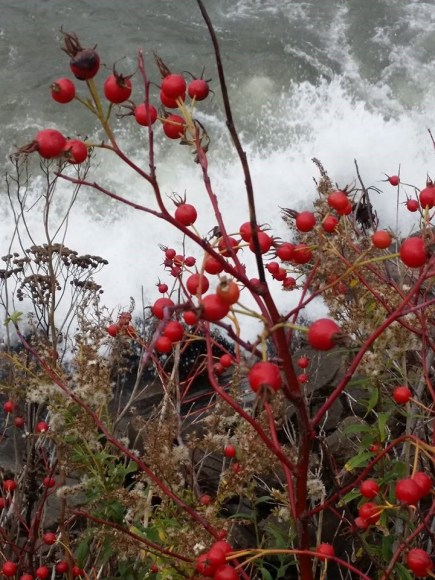
I am composed by the ink of Mama Nature’s blueprint to discover Wild Rose growing peacefully on the dunes and rocky shores of the Big Water to the plains of Jack Pine. Like her sister the apple, she is a wild child of the five star-petaled Rose Family. Pretty in pink, Rosa acicularis appears delicate, yet her feminine mojo is a sub-arctic generator not just of pretty things – she is also rooted in old world plant wisdom, nurturing life around us and in us.

With Autumn’s equinox, her hips are ripened and ready to harvest. Each rose berry is red, round and fleshy – pregnant with a belly of seeds. She asks us to be patient and wait until the first frost energizes her life force with a higher concentration of Vitamin C. This is her elegant equation to answer winter’s call. Vitamin C is optimal when ingested as a whole food, rather than by pill or in capsule form. Wild Rose encourages us to stay with what comes naturally, following this sweet timing, as each seed of good work today is the fruition of tomorrow.

A pouch is helpful for collecting each berry with blessings and patience. Upon harvest, wash and dry your rose hips. Cut open each from top to tail. I use a butter knife to clean out all seeds and fuzzy hairs as they will tickle the throat if not removed. Once cleaned, place on a cookie sheet and re-check that all seeds and fuzzies have been removed. She is a wild food and ready to serve.

Indigenous plants usually have more than one job to do, and Wild Rose is no exception. Begin your relationship with her authentically by keeping your interactions simple. I have made rose hip honey, “the Nectar of the North,” by packing a sterilized jar full of clean, freshly cut rose hips and infusing to the tippy-top with raw local honey. Place your filled, closed jar in a cool, dark cupboard for about six weeks, allowing the goodness of Bee and Hip to synergize flavonoids and Vitamin C along with other vital vitamins and minerals. Once infused, no need to press the hip from the honey, but “in joy” on toast, as a yogurt topping, in home-made dressing, and/or as a skin mask. 

Heat deteriorates Vitamin C levels so I dapple rose hip honey on my pancakes rather than baking it in them. Rose hip honey nurtures children, and carries a faint fragrance similar to apple. The water solubility of its Vitamin C makes it especially lovely in mint tea. This combo is my constant companion during winter’s stay.
I invite you to discover and cultivate your relationship with Wild Rose to raise your health and happiness. May your discovery be her gift.

KimAnn Forest is a wild-harvest herbalist of our beloved U.P., a life ceremony officiant, and crystal bowl sound healer. Email:waldorf1988@yahoo.com. Facebook: KimAnn Forest.

Photo courtesy of KimAnn Forest.

Excerpted with permission from Health & Happiness U.P. Magazine, Fall 2018 Issue, copyright 2018. All rights reserved.

Special Fall 2018 Issue in Honor of Women is Out!

HH 45 Cover 2So proud of all the wonderful contributions to this special issue! “Restoring Hope at Restoration Bakery,” Positive Parenting and Authentic Friendship articles by Crystal Stone, “Cookbooks” for Green Living by Steve Waller, “Women’s Rights through the Years” by Karlyn Rapport, “The Gifts of Wild Rose” by KimAnn Forest, and much more await you in our new issue!

Yoopers, click here to find out where in our 8-county area you can pick up your copy!

Not in the U.P., or want your copies delivered to your door anyway? Get a 1-year subscription for $15 + FREE SHIPPING!
Buy Now Button

Green Living: Time for a Happy Walk! by Steve Waller

Feeling stressed, tired, angry, lonely, or sleepless? Fighting weight gain or aging? The fountain of youth exists—only two feet away, literally. Look down and count. Two feet? You’re all set. Park the car. Start Happy Walking!

We are built to walk! Our ancient ancestors walked out of Africa to the ends of the earth – Europe, Asia, the Americas, the U.P! The average American spends nine to ten hours a day sitting or driving cars. We’re becoming wimps. If we were built to drive cars, we’d have only one foot!

Google “benefits of walking.” Walking helps you lose weight, reduces stress (lowering blood pressure), decreases anger and hostility (makes you nicer), and reduce the risk of many chronic diseases. A regular 15-30-45 minute walk is one of the best (cheapest) and easiest things you can do for your health.

Walkers think more creatively than sitters. Walking opens up the free flow of ideas, increases metabolism by burning extra calories, and prevents muscle loss. Walking triggers your body to release natural pain-killing endorphins. A 10-minute walk may be as good as a 45-minute workout to relieve the symptoms of anxiety. You don’t need to slog it out on a treadmill at the gym for these benefits.

Walking in nature, specifically, reduces dwelling over negative experiences, which reduces the risk of depression. Walks with a partner, a neighbor, or a good friend help you feel connected, which boosts mood. Just twelve minutes of walking can increase joviality, vigor, attentiveness, and self-confidence versus the same time spent sitting. The more steps people take during a day, the better their mood tends to be. Walkers are happier!

Since walking doesn’t wear down your body much, it doesn’t require recovery time. For those who are fit, walking is a phenomenal maintenance activity, keeping you healthier into old age.

So, instead of driving to a gym to work out, walk to the gym’s front door. Do Not Enter. Shout out loud, “I walk!” Turn around. Walk home. Your workout is done. No monthly fee!

Start with a walk in the neighborhood. Take it easy at first. Bring the kids. Be neighborly. Walk to the local grocery. Why drag 4,000 lbs of automobile along to buy a 10 lb. bag of goodies? Grab a comfortable recycled bag or backpack or borrow a neighbor’s wagon or a stroller for strolling, and walk. Plan weekends exploring many of the local short or long foot trails awaiting your footprints. (https://www.traillink.com/state/mi-trails/.)

Ready for an adventure? The Iron Ore Heritage Trail traverses 47 miles across the Marquette Iron Range. It’s an outdoor linear mining history museum where you exercise your body and mind with interpretive signage, artwork and connections to museums along the way. http://ironoreheritage.com/

The North Country Trail (NCT) is a 4,600 mile footpath stretching from eastern New York to central North Dakota. As of early 2017, 3,009 miles of the trail are in place, passing through seven states. The longest stretch is 1,000+ miles split evenly between upper and lower Michigan.

In the beautiful Upper Peninsula, the NCT stretches 167 miles from the Mackinac Bridge to the Luce/Alger County border, just east of Grand Marais; 188 miles from Grand Marais through Marquette to the Marquette/Baraga County Line on the eastern border of Craig Lake State Park; then 192 more miles to the MI/WI border near Ironwood. (https://northcountrytrail.org/trail/michigan-upper/)

Do it all or maybe just a part, or just one part at a time. Walking outdoors exposes you to natural sunlight. Walking with groups of friends outdoors exposes you to fun and creative thought.

Buy less gasoline. Walk. You’ll be happier!

Steve Waller’s family lives in a wind- and solar-powered home. He has been involved with conservation and energy issues since the 1970s and frequently teaches about energy. He and a partner own a U.P. wind/solar business called Lean Clean Energy. He can be reached at Steve@UPWallers.net.

Excerpted with permission from Health & Happiness U.P. Magazine, Summer 2018 Issue, copyright 2018. All rights reserved.


Inner Nutrition: Overcoming Our Disease of Dis-Ease, by Keith Glendon

As I read an inspirational article on the Internet the other day, I noticed tension building in my chest. I felt slightly inadequate. I watched a cloud of self-doubt form over my perspective. I became curious—why was this inspiration bringing me down? In the coming days, a pattern emerged. I noticed more articles on the Internet. More news headlines and connotations. More advertising and social media event invitations. It seemed wherever I turned, there was a common message: ‘Do more, achieve, strive, compete, stand out, be everything, have it all!’ I was un-inspired. Instead of motivating me to greatness, the undercurrent seemed to shout “You’re not enough!!”

Leonardo da Vinci spent sixteen years delaying his work on the Mona Lisa. For several years, the painting just sat there unfinished. He was criticized for dabbling in distractions that spanned painting and sculpture, music, the sciences, architecture, and other pursuits that kept him from progressing in the eyes of many as an artist. What his critical contemporaries didn’t recognize was that da Vinci’s rambling genius and creative process simply didn’t work along a timeline. He needed time, distraction, procrastination, unstructured puttering. It wasn’t about achievement or greatness but the process of exploring his unique interests and gifts, giving his piece into the flow of things.

After I caught myself being sideswiped by dark feelings from the “inspiration” with which I was being bombarded, I was reminded of the recent passing of my dad’s wife. Gail enjoyed many things but one thing she loved was quilting. A talented craftswoman, she always had a few quilt projects underway. Her creations were expressions of joy and of love. They were often gifts to those for whom she cared. They were artwork and simple, functional beauty – the product of her creative soul expressed in fabric. They were a gathering of friends. They were an investment of her heart. At times, she was intensely-focused at work on her quilts. Other times, projects would sit there in a corner while she read a book, gardened, or went on long bike rides with Dad. Taking time, setting aside, relaxing into life was an essential part of the process.

Gail was taken by disease. Cancer was the culprit. In life, though, she didn’t live in dis-ease. She didn’t strive or compete or seek to stand out or have it all. What she did have was joy in simple things, dedication to creativity, quiet consistency in her passion and love. She shared it freely. She took her time. Not long after she passed, Dad and I stood on a beach at sunset. As I felt his grief, I also felt gratitude for the quiet moment. The beauty of the sky. The lesson in Gail’s life.

There is a disease of dis-ease sweeping our world. Lest we lose our lives to it, let us remember it’s okay to take our time, to dabble, to be distracted, to simply be. In this fast-and-furious ‘modern world,’ let’s remember to express our love, take walks, enjoy one another’s company, create, garden, ‘waste’ time together. Let’s remember it’s okay to be at ease.

Keith Glendon is a grateful husband, father of four, writer, poet, global technology something-or-other, and generally life-loving seeker, learner, and gratitude-spreader. Having grown up in Marquette, traveled the world, and returned to settle in his hometown, he now focuses on being Daddy and offering what he can to the flow.

Excerpted with permission from Health & Happiness U.P. Magazine, Summer 2018 Issue, copyright 2018. All rights reserved.

Healthy Cooking: Quinoa, Queen of the Grains for an Active Summer, By Val Wilson

Quinoa (pronounced ‘keen-wa’) was the mother grain of the Incas. They considered it sacred and held ceremonies honoring quinoa.  In South America, in the high altitudes of the Andes mountains, quinoa has been grown, harvested, and eaten since at least 3,000 B.C. Because of its hardiness, being able to survive at such high altitudes, quinoa is considered a strengthening food.

Although botanically quinoa is a fruit, we classify it as a whole grain. In fact, quinoa is the signature whole grain for summer time. As one of the easiest whole grains to digest, it gives us a tremendous amount of energy so we can be very active in the summertime. Quinoa is high in calcium, phosphorus, iron, vitamin E, magnesium, and manganese, and is a complete protein. Quinoa is high in quercetin and kaempferol, two flavonoids that have anti-inflammatory, anti- viral, anti-cancer, and anti-depressant properties.

Quinoa cooks up quickly and has a nutty flavor, making it ideal for creating cold salads for summer.

Quinoa, Black Bean and Fresh Basil Salad

1 cup quinoa
2 cups water
4 cups broccoli (cut up)
2 scallions (thin, round slices)
1 carrot (grated)
3 radishes (grated)
1 cup corn
1/4 cup minced parsley
1- 15 oz. can black beans (drained)
Dressing:
3 T. tamari
3 T. brown rice vinegar
2 T. olive oil
2 garlic cloves (minced)
3 T. fresh basil (minced)

Put the quinoa and water in a pot and bring to a boil. Reduce to the lowest possible temperature, cover, and simmer for 15 minutes, until all the water has been absorbed. Put hot quinoa and corn in a bowl and stir together. The heat from the quinoa will lightly cook the corn to bring out its flavor. Steam the broccoli until fork tender, approximately 7 minutes. Add broccoli to the bowl along with the scallions, carrot, radishes, parsley, and black beans. Whisk together the dressing ingredients and pour over the salad. Mix all together and serve at room temperature or refrigerate and serve cold. 

Chef Valerie Wilson, a.k.a, Macro Val, has been teaching cooking classes since 1997. Visit her website to purchase her cookbook, Perceptions in Healthy Cooking Revised Edition, set up a phone consultation, or listen to her radio show, http://www.macrval.com. Facebook, Macro Val Food.

Excerpted with permission from Health & Happiness U.P. Magazine, Summer 2018 Issue, copyright 2018. All rights reserved.

Bodies in Motion: The Take-It-Anywhere Summer Workout

With warmer temperatures and longer days, hopefully you’re finding more time to get outside! Along with your favorite summer activities, I always recommend adding light stretching and strengthening to keep the whole body in check.

If you’re looking for a quick, balanced workout, try the “Basic Five” Pilates Mat exercises. In under ten minutes, this routine will have you feeling stronger and longer. And the best part? You can take it with you wherever your summer sweeps you…

THE HUNDRED
Start lying on your back with your arms by your sides and your legs extended (Modification: knees bent, feet on the mat). Take a deep inhale.

On your exhale, lift your head and the tops of your shoulders to come into an ab curl. Simultaneously float both your legs and arms a few inches above the mat.

Pump your straight arms by your sides, inhaling for five pumps, and exhaling for five.

After ten full breaths, or 100 pumps, you are done, my friend!

ROLL UP
Lie on your back with your legs extended and your arms reaching up toward the ceiling.

On an inhale, start to curl up slowly, trying to articulate each vertebra as it leaves the mat.

Exhale to finish your curl, rounding your spine over your legs while your fingers reach toward your toes.

Inhale as you tuck your tailbone underneath you and slowly lower your spine back to the mat, one vertebra at a time.

When the tips of your shoulder blades hit the mat, exhale to lower yourself back to your starting position.

Repeat five to eight times.

SINGLE LEG CIRCLE
Lie on your back with your legs extended and your arms down by your sides.

Extend your right leg up toward the ceiling, straightening it as much as your hamstrings will allow.

Inhale as you take the right leg across the midline of your body and then exhale as you return to your starting position. Repeat this five times and then switch the direction of your leg circle.

When you reverse the circle, inhale as your leg travels away from you, and exhale as it crosses the midline to return to your starting position. Repeat this five times.

Place your right leg down, and complete the whole series on the left leg.

ROLLING LIKE A BALL
Take a seat on the mat, floor, beach…wherever you are. Draw your heels in toward your sitting bones with your feet in a V shape. Your knees will be wide, like a frog.

Wrap your arms tightly around your legs so that each hand is on the opposite shin.

From here, “scoop” your belly to flex your spine and tilt back to float the feet off of the mat, floor or beach. Try to stabilize here for at least a moment.

Inhale as you tip back to the tips of your shoulder blades.

Exhale as you roll back up to your starting position, but don’t let your feet hit the mat.

Repeat five to eight times. And have fun!

SPINE STRETCH
Take a seat with your legs extended wide in front of you, toes flexed back toward your shins.

Reach your arms toward the sky. Inhale fully here.

On your exhale, start by tucking your chin to your chest, and then slowly curl yourself down toward your legs – vertebra by vertebra.

Inhale to stack yourself back up to your starting position.

Repeat five to eight times.

So how do you feel? Hopefully energized and ready to enjoy summer. If you have any questions on the Basic Five or other ways to keep your body balanced, you know where to find me – info@birdonaperch.com.

IMPORTANT: When participating in any movement practice, please remember to listen to your body and avoid exercises that don’t feel safe. If you are suffering from an injury or a medical condition, please consult your doctor before engaging in any new activities.

Allison Cherrette is a PMA-certified Pilates instructor and a graduate of the Advanced Teacher Training program through The Pilates Center of Boulder. She owns Bird On A Perch, a Marquette Pilates studio offering group and privates lessons on the Mat, Reformer, Tower and Chair.

Excerpt from Health & Happiness U.P. Magazine, Summer 2018 Issue, copyright 2018.