Blog

A Fresh Look at… Genealogy & Social Harmony, by Tyler Tichelaar

Genealogy was her favorite insanity. — Anthony Trollope

crown
When I start talking about genealogy, people often don’t understand how
I can get so excited about dead people. They might think the only reason
people are interested in genealogy is to claim descent from royalty or
someone famous. But genealogy teaches far more than ancestral pride.

My interest in genealogy began from stories my grandfather told me
about growing up in Marquette. After his death, I wanted to learn more
about my family, including why they had come to Marquette. To find out,
I visited the local cemeteries, the Family History Center at the LDS
Church in Harvey, the County Courthouse and the Marquette County
History Museum. I discovered my ancestor, Basil Bishop, had owned a
forge in New York and came to Marquette to work in the iron industry.
After learning a great deal about my Marquette ancestors, I decided I
wanted to know about their ancestors.

 
I learned Basil Bishop’s father and grandfathers had fought in the American
Revolution. Their ancestors had been New England Puritans. I discovered a
vast amount about the Puritans from researching those family members.
The most prominent ancestor was Thomas Dudley (1576-1653), second
governor of the Massachusetts Bay Colony. He presided over the notorious
Anne Hutchinson trial and signed the charter to establish Harvard College.
Although Dudley is not a household name today, his contributions to
American history are vast. His descendants number in the tens of thousands
and include Supreme Court Justice Oliver Wendell Holmes and Presidential
Nominee John Kerry. But what about Governor Dudley’s ancestors?

Have you ever considered how many ancestors you have? You have 2
parents, 4 grandparents, 8 great-grandparents. Each generation back,
the number doubles. Thomas Dudley is my 11-greats grandfather—one
of 8,384 ancestors in that generation, and one of only 6 whose names I
know. I wish I knew the other 8,378 ancestors’ stories.

 
Another 7 generations back, to my 18-greats grandparents, provides over
one million ancestors in that generation. However, the numbers do not
consistently double because people married someone who was at least a
distant cousin, so many ancestors appear multiple times in a family tree.
The result—everyone ends up related in multiple ways. In fact, Thomas
Dudley is descended from King Alfred the Great (reigned 871-899) by 28
different lines.

 
My point isn’t to impress you with my ancestry but to reveal the human
family’s closeness. DNA research reveals that everyone of European
descent alive today is descended from everyone who lived in Europe and
had children before 1200 A.D. (See Mapping Human History by Steve
Olson). That means every white person alive is descended from
Charlemagne, Alfred the Great, and William the Conqueror.

 
Consider how such a connection affects questions of race. When people
ask what nationality I am, I might say Dutch or Irish because my ancestors
came to the United States from the Netherlands or Ireland, but because
I’m descended from everyone who lived in Europe and had children before
1200 A.D., I have ancestors from every European country from Spain to
Finland to Hungary to Greece. I’ve done the research to confirm it.

Genealogy proves that race does not exist. For example, one of Thomas
Dudley’s ancestors was King Edward III of England (reigned 1327-1377).
Was he really English? His mother was Isabella, Princess of France.
Isabella’s grandmother was Princess Isabel of Aragon (now part of Spain).
Her mother was Jolan, Princess of Hungary. Her great-grandmother
was a Russian princess, who was descended from Swedish royalty.

Racism becomes ridiculous when you consider the bigger picture. In
1066, William the Conqueror of Normandy defeated Harold the Saxon
King of England. I’m descended from both of them. Which side do I
take? I’m descended from Irish kings as well as the English kings who
invaded their lands.

 
Recently, I discovered I have Asian ancestors. One of my European
ancestors was a Byzantine emperor. He married a Persian shah’s daughter.
Her ancestors included Indian maharajahs and Chinese emperors. Xerxes
the Great (known today from the movie 300) is one of my countless Asian
ancestors. I may not look Chinese, Persian or Indian, but their blood
is mingled in me with the French, Polish, Hungarian and Swedish. No
doubt I have African ancestors also, whom I look forward to discovering.

My ancestry is your ancestry. Race does not exist. It’s time we realized
we are all one family and we need to get along.

 
Editorial note: Explore your own family history by joining the Marquette
County Genealogical Society, searching online at familysearch.org, researching
county records, and interviewing family members.

 
Tyler R. Tichelaar is the author of The Marquette Trilogy and recently
published The Children of Arthur series. Genealogy research inspired his
novels. For more information, visit http://www.MarquetteFiction.com.

Reprinted with permission from the Summer 2009 issue of Health & Happiness U.P. Magazine, copyright 2009. All rights reserved.

*Join us for Myth-Busting & Self-Help Tips: YOUR Health & Happiness Forum, Saturday, Sept. 30th 2017, 1 pm – 4 pm in the Community Room on the lower level of the Peter White Public Library, Marquette, MI, and help us celebrate our 10th Anniversary.  Click here for more info!

**FOLLOW us here and/or on Facebook to be entered to WIN in our 10th Anniversary drawing! 

Inner Nutrition: What Camp Means to Me, by Christine Saari

Photograph by Christine Saari


It all began with a clearing in the woods cluttered with ramshackle buildings from a former homestead: the remains of a cabin, a leaning barn, a decaying pig sty and chicken coop. I was horrified to learn this was to be the site for our camp. Why would we want a camp to begin with when we lived amidst a beautiful landscape waiting to be explored? “I’ll never come here,” I said to my husband. If he wanted a camp, so be it. I did not!

Jon proceeded without me. One day he took me to the transformed site – the buildings were gone, the clearing pristine. Then he purchased a 100-year old log cabin which had brambles growing inside and no windows and doors. Again I was aghast. But Jon was undeterred. The building was taken apart, transferred and rebuilt. Trees were felled for replacement logs, windows cut, doors made, layers of wallpaper stripped off the cedar logs. Endless work, but I participated, helped lay the floor, chinked, found furniture, worked to make the place cozy.

The two-story cabin has been proudly standing in our clearing since 1994, over time joined by a two-seater outhouse bought from an aunt, a shed and sauna rescued from a pasture for cows who rubbed the dovetailed corners round. Finnish relatives equipped the smoke sauna with a hearth and benches, and a deck was added to the house.

Although I said I’d never come, I have grown to love our camp above the West Branch of the Whitefish River. Why? What does camp mean for me?

With a thirty-mile trip, it is close enough from home to come for just an evening in the summer or for an overnight stay. Of course, if we can we stay longer, but whatever the length of our visit, we return to town refreshed.

Thanks to the “primitive” nature of the place – no electricity, a spring in the woods, a wood stove, life there slows down immediately. We forget about the news, e-mail or phone connection. Instead we make sure the kerosene lamps are filled for the evening and that there is enough wood to stay warm. This is a place just to be. We cook simple meals, talk, write letters, read and play scrabble. We take time to take a nap, we go to bed early. In summer we take canoe rides on the river, in winter we ski. We watch the natural world around us: a wild turkey has lost a beautiful feather, irises are blooming on the shore, a heron flies overhead.

Although we are close to a road, we seem far away from civilization. I can sunbathe unobserved. There are berries and mushrooms and flowers to pick. The stars shine brightly at night, the moon lights up the clearing, fireflies glow in the dark. Because the area is small, we have gotten to know it intimately. Every time we come we see changes. The river swells from melting snow, spring leaves unfold, white trilliums cover the dark forest floor. Here we are aware of the annual cycle of growth and decay and of our place in this universe.

Aside from all that, at camp we are surrounded by our ancestors: the flour bin reminds us of Jon’s grandmother’s farm. Jon’s father brought the cuckoo clock from the war in Europe, and camp brings me back to my childhood, to the Austrian mountain farm without electricity and running water where I grew up. Here I am connected to the past and to nature. Here I feel whole.

Christine Saari, an Austrian immigrant,  is a writer and visual artist. She has published a book, Love and War at Stag Farm, The Story of Hirschengut, an Austrian Mountain Farm 1938-48. It tells the story of her family in Austria during WWII and its aftermath.

Reprinted with permission from the Summer 2012 issue of Health & Happiness U.P. Magazine, copyright 2012. All rights reserved.

*Join us for Myth-Busting & Self-Help Tips: YOUR Health & Happiness Forum, Saturday, Sept. 30th 2017, 1 pm – 4 pm in the Community Room on the lower level of the Peter White Public Library, Marquette, MI, and help us celebrate our 10th Anniversary.  Click here for more info!

**FOLLOW us here and/or on Facebook to be entered to WIN in our 10th Anniversary drawing! 

You Could Win! Enter our 10th Anniversary Drawing

What do YOU love about Health & Happiness U.P. Magazine?

Comment below or on our Facebook page to be entered in an Oct. 1, 2017 drawing to WIN a $50 gift certificate from your choice of 1 of the following:
the Marquette Food Co-Op, Keweenaw Food Co-Op, or Empowering Lightworks.
(New comments only qualify for drawing entry; repeat comments do not apply for drawing entry.)

Receive additional entries by FOLLOWING us here and/or on our Facebook page, (1 entry per “Follow”) and *TWO* more entries by SHARING this post on Facebook!

Help us SHARE more Health and Happiness all around!

Natural Medicine: 6 Suggestions for Breathing Into Letting Go This Fall, by Alicia Smith

As the colors start to change on the trees and days start to get shorter, we humans may start to feel something in our bodies. This “feeling” could make us crave warmer liquids or commercialized pumpkin spice latte.

Looking around, we can notice other hints of fall such as animals beginning to harvest away food for cooler times.

Emotions of Fall

Being in the UP, some of us may have mixed feelings about fall. Perhaps we have thoughts such as “I used to like the fall but now it gives me anxiety about the cold winter to come.” Or students associating fall with sadness about going back to school, missing the beach.

Believe it or not, feeling a hint of sadness in the fall is healthy. As humans we go through the cycles within nature. Fall is associated with the Metal element which relates to sadness/grief in Chinese Medicine. Fall is about letting go. In nature, fall trees physically let go of their leaves.

Metal Imbalance

A metal imbalance emotionally could mean difficulty with letting go of things, situations, events, relationships, sadness, and a longing for the past. Physically, a metal imbalance could mean skin issues, asthma flare-ups, upper respiratory illness, nasal congestion, constipation, too much or too little mucus, and frequent illnesses/compromised immune system.

Self-Care for the Fall

1.) Food: Let us start with the concept of food being our medicine. Foods that help our lungs breathe are pungent foods. Pungent foods cleanse and protect the delicate lung organ by moving and dispersing phlegm or mucus. Think onion, garlic, cinnamon, clove, nutmeg, saffron, pepper, ginger, leek, mustard leaf, and parsnip. Dairy foods contribute to mucus build up. As Chinese Medicine Dietary Theory states, to reduce excess mucus in the lungs, eat less dairy.

2.) Sun Watching: When nature starts the shift to shorter days it is beneficial to sun watch. Being in synch with the sun’s rhythm is balancing. Any night shift worker can most likely relate to feeling confusion when going to sleep while the sun is rising.

Even for just for the fun of it, get up and watch the sun rise. Then watch the sunset that same day. Kudos to those who already have a close relationship with the sun!

3.) Pick Up Some Smells: Walking outdoors, smelling the leaves and new smells of fall help the body transition. Some essential oils that can be beneficial are silver fir, grand fir, and rosemary.

4.) Let Go of Something: People say we forgive for ourselves vs. others. Forgiving someone allows us to move forward with our life. Or maybe we need to forgive ourselves for something that happened years ago.

5.) Learn Something New: In the spirit of the back-to-school season, regardless of your age, learn something. Join a book club, volunteer in your community, pick up a new hobby, or, go back to school!

6.) Get Routine Care With An Acupuncturist: Most acupuncturists will take into consideration the change of seasons and help your body get a “tune up” by picking lung points as a part of your acupuncture session.  If you have difficulty with fall, potentially your metal element needs balancing. Furthermore, health issues with the lung and colon suggest unresolved grief and sadness in Chinese Medicine.

Autumn’s Gift 

The true beauty of letting go is feeling lighter. At first, letting go may seem difficult. Remember all of nature around you is supporting the letting-go cycle. With practice, the mind, body, and spirit can flow with the seasons, and to a deeper level of flow with the dance of life.

Alicia Smith practices acupuncture in Marquette, MI and Escanaba, MI for women, men & children. She runs a general family care practice. She has a special interest in dermatology, depression/anxiety, fertility, women’s health, pediatrics & pain management. Alicia owns and operates The Light Institute, a wellness cooperative. The Light Institute has healing houses in Marquette, MI and Escanaba, MI.

Reprinted with permission from the Fall 2014 issue of Health & Happiness U.P. Magazine, copyright 2014. All rights reserved.


Positive Parenting: Brattiness or Brain Development? Important Facts About Your Little One, by Kathy Harsch

Challenging behavior  – why does it seem to be right in front of us, perhaps more often than we would like?!   I would like to empower those who have daily interaction with young children. With the power of knowledge, you will be better prepared to respond to and deal with conflict.   Knowledge of child development will help keep your young relationship in good standing.

Did you know that before the age of six, information is processed twelve times slower than in adults?   Children six to twelve process information six times slower than adults!   What does that mean?   When we walk into a room and quickly announce we need to leave; Mommy has a meeting and I need you to turn off the TV, get your shoes and backpack, and a jacket just in case it cools down;  we need to leave in just a few minutes, so be quick!”   Rarely does this common scenario take place without Mom or Dad getting flustered.  Try this – while turning off the TV, give the command, “get your shoes and backpack.”   Truly adults need to s. l. o. w. the pace down!

How many times a day have you said the word “don’t”?   Young children cannot conjugate the word “don’t” and therefore when you say “don’t throw the sand”, they hear “throw the sand” and you march over to the sandbox with the “challenging me again” thought!   We need to tell children what to do!   “Use the bulldozer to move the sand!”   It takes work to tell children what we want them to do. “Don’t” really doesn’t give them any information and “no” certainly doesn’t provide more information either.  Instead, tell children what to do.   Teach them what YOU want them TO DO!

Children under seven lack mature “inner speech.”    In adults, inner speech is like a rehearsal for what we may want to say when arriving at a new acquaintance’s place or how we might want to prepare a meal.   We can even quickly think “oh, what I would like to say” but use our filter and think before we act!   Young children see in pictures.   Adults need to paint a picture with their words. Remember, don’t” and “no” provide no information. For example, “You seem anxious, you pushed your friend when you walked into the room.  You may not push, you may come to me and stand by me if you feel anxious.” Using descriptive language helps defuse those unwanted verbal power struggles and is also a stepping stone for language and literacy, so utilize it as often and fully as possible.

If you’re in the teaching field or just simply read to children, it’s helpful to know that binocular vision, the ability of both eyes to focus on the same subject, doesn’t fully mature until around age six.   Until then, it is like covering one eye, spinning around and trying to walk down steps!   Reading a story to children and moving the book in front of their eyes is continuous motion.   In a group you’ll get the child in front saying, “I didn’t see the picture!”   They follow the book and the children in back begin to say, “I didn’t see the picture!”   Suddenly everyone is scooting, on their knees, and saying, “I didn’t see the picture!”   Instead, hold the book still, move it, then hold it still again.   We should pay attention to children’s behavior. Though it appears to us that they’ve seen the picture, they haven’t and they are not making it up!

There is so much we can do to help children plug into the rational part of the brain.   We can do the same!   Be a S.T.A.R. – Smile, Take a deep breath, And Relax!   I know you can do it! Teach your child or children the same.

Kathy Harsch has followed Dr. Becky Bailey’s teachings since attending her 2000 Marquette Early Childhood Conference presentation. She’s since attended many of Dr. Bailey’s conferences and continues to teach and learn from Conscious Discipline, School Family, and Brain Smart ways, incorporating them in her day care.

*Conscious Discipline™, School Family T, and Brain Smart™, are trademarks of Loving Guidance, Inc.  1-800-842-2846   www.ConsciousDiscipline.com.

Reprinted with permission from the Fall 2012 issue of Health & Happiness U.P. Magazine, copyright 2014. All rights reserved

Healthy Cooking for Fall, by Val Wilson

When cooking tasty fall dishes it is important to use rich, aromatic seasoning to satisfy our taste buds. We have been enjoying the light fare of summertime foods and now it is time to add more seasonings and richness to our food. In the fall we turn our ovens back on and enjoy casseroles and start to crave warming soups.

Two important seasonings we can enjoy in the fall are toasted sesame oil and tamari. Toasted sesame oil has a nutty, earthy flavor that works very well when sautéing. A unique natural by-product of sesame seeds, sesamol, protects sesame oil from oxidation. This means the oil is less subject to rancidity and loss of flavor over a period of time. Toasted sesame oil is also high in linoleic acid, one of the three essential fatty acids our body cannot produce. Tamari is a wonderful, salty condiment used to flavor all kinds of dishes. It is simply the salty liquid that comes from the fermenting of soybeans. Good quality tamari contains enzymes and amino acids that aid in digestion. Tamari also has the unique ability to neutralize the extremes of being over acidic or over alkaline. The lactic and phosphoric acids in tamari absorb excess of being over alkaline. And the saline nature of tamari acts upon acid foods to neutralize them. When shopping for tamari it should be wheat free and naturally fermented.

Brown Rice, Tempeh and Squash Casserole

3/4 cup brown rice
1/4 cup wild rice
2 cups water
1 package tempeh
1 onion (diced)
4 cups butternut squash (cut in cubes)
3 cups chopped portabello mushrooms
5 garlic cloves (minced)
1 tsp. basil
1/2 tsp. sage
1/2 tsp. Paprika
Sauce
1/4 cup water
1/4 cup tahini
2 T. tamari

Pot boil the two rices in the 2 cups water for one hour. Steam squash until fork tender. Sauté the onions in toasted sesame oil and a dash of tamari until translucent. Add garlic and sauté for just one more minute. When done, put in a large bowl. Using the same pan sauté the mushrooms, when done add to the bowl. Still using the same pan, brown the tempeh in toasted sesame oil and tamari, and add to the bowl. Whisk together the sauce ingredients and add along with the rice and steamed squash to the bowl. Add spices and mix all together. Pour into an oiled casserole dish and bake at 350 degrees for 30 minutes, uncovered.

French Onion and Black Bean Soup

2 onions (thin half moons)
toasted sesame oil
tamari
8 cups water
3 (15 oz.) cans of black beans (drained)
6 T. tamari
1 tsp. basil

Chef Valerie Wilson, a.k.a, Macro Val, has been teaching cooking classes since 1997. Visit her website; to purchase her new cookbook, Perceptions In Healthy Cooking Revised Edition, set up a phone consultation, or listen to her radio show, www.macroval.com. Facebook, Macro Val Food. 

Reprinted with permission from the Fall 2007 issue of Health & Happiness U.P. Magazine, copyright 2007. All rights reserved.

Boost Your Brain Power + 10th Anniversary Celebration

In celebration of our 10th Anniversary, Health & Happiness is posting some of its best articles from its first 10 years throughout the month of September.

If you like what you read here, please LIKE and SHARE this post, FOLLOW our site, and JOIN us on our Facebook page.

And if you’re in the Marquette area on Sept. 30th, please join us in celebrating our anniversary at YOUR Health & Happiness Forum from 1 pm – 4 pm in the Community Room of the Peter White Public Library.

Stay posted for more details! And please enjoy the 4th article of 10 in our 10th Anniversary Celebration September Retrospective Series!

How To Boost Your Brain Power

by Dr. Jessica Nagelkirk

While you’re awake, your brain generates 10-23 watts of power. That’s enough power to light up a lightbulb. If you ever feel like your mental power could never produce a dim glow of a light bulb, read on for simple steps you can take to boost your brain power.

Exercise
Hundreds of research studies over the past decade have found that physical exercise leads to changes in the brain that improve its function. The hippocampus, the part of the brain involved in learning and memory, has been found to increase the number of nerve cells with exercise. In a study of mice, it was found that mice that were allowed to exercise had double the number of new nerve cells in the hippocampus compared with mice that were sedentary. Not only does exercise increase the number of neurons in your brain, but it also increases blood flow to the brain, which allows it to be bathed in the nutrients needed for optimal functioning. Monkeys who exercise for one hour a day, five days a week, have demonstrated increased alertness, attentiveness, and the ability to learn new things faster, regardless of age.

Nutrition
Neurotransmitters are chemicals that communicate with the nervous system, including the brain. You have probably heard of serotonin and its association with depressed mood, but it, along with other neurotransmitters including acetylcholine, plays a role in memory. In order for neurotransmitters to function properly, they require additional nutrients called co-factors. These cofactors are nutrients such as B vitamins, magnesium, zinc, and other vitamins and minerals. Many of these cofactors can be found in green leafy vegetables and protein. Including a healthy fat in your diet is also really important, as your brain is 60% fat! Healthy fat sources include avocados, olive oil, flax oil, nuts and seeds, grass-fed organic butter, and oils from fatty fish.

You might also want to steer clear of processed foods and pesticides, choosing organic whenever possible. A study of students in New York showed that students who ate lunches free of artificial flavors, preservatives, and dyes scored 14% better on IQ tests than students who consumed those additives.

Sleep
While you sleep at night, your brain works hard to consolidate your memories from the day. Not getting enough good quality sleep actually decreases your ability to form new memories. Set yourself up for success by having a bedroom designed for sleep. Try to sleep in total darkness, with blackout drapes if possible. Your bedroom should also be free of electronics that produce electromagnetic frequencies . If you sleep with your phone next to your bed, try moving it across the room. Millions of Americans watch TV and work on their computers in bed, a bad habit if you’re trying to get good quality sleep. The bedroom should only be used for sleeping and intimate moments.

Supplements and Herbs
There are many products out there to enhance brain function. Some ingredients that I occasionally use temporarily to support the brain are:

  • Essential Fatty Acids (EFAs) found in fish oil or krill oil: An omega-3 fatty acid found in fish oil, called DHA, is the primary structural component of the human brain. Low levels of DHA are associated with cognitive decline.
  • B Vitamin Complex: B vitamins are important co-factors for millions of processes that happen in your body every day which help support mental and cognitive health. Choosing methylated forms of B vitamins like folate and cobalamin are important for some individuals, as a common genetic defect prevents some of the population from turning the inactive forms of these vitamins into active, usable forms.
  • Rhodiola Root Extract: This plant is used in traditional medicine in Eastern Europe and Asia to enhance physical and mental performance. Studies of the plant have actually shown improved physical and mental performance, reduced stress-induced fatigue in humans, and improved stress symptoms in general. I typically use this herb with the “worn out student” type person.
  • Probiotics: Health begins in the gut. Probiotics can help restore the balance of good bacteria and improve the assimilation and absorption of the nutrients you need for proper brain function. If you can’t digest food well, it makes getting the nutrients you need for brain function difficult.

There are many medical conditions that impair mental function, such as attention deficit and hyperactivity disorder (ADHD), dementia, or even clinical depression. Low iron stores (serum ferritin), zinc deficiencies, food allergies, and heavy metal toxicity have all been associated with ADHD symptoms and poor cognition. If you or your family member experiences difficulty with brain function or completing tasks, it’s important to have an evaluation by a physician to make sure the underlying problem is identified and addressed before you self-treat with herbs or supplements.

Dr. Jessica Nagelkirk is a licensed Naturopathic Physician (ND) specializing in integrative primary care medicine. She is a current faculty member at National College of Natural Medicine in Portland, Oregon and sees patients privately at U.P. Holistic Medicine in Marquette, MI.

Reprinted with permission from the Fall 2014 issue of Health & Happiness U.P. Magazine, copyright 2014. All rights reserved.

Healing Hearts + 10th Anniversary Celebration

In celebration of our 10th Anniversary, Health & Happiness is posting some of its best articles from its first 10 years throughout the month of September.

If you like what you read here, please LIKE and SHARE this post, FOLLOW our site, and JOIN us on our Facebook page.

And if you’re in the Marquette area on Sept. 30th, please join us in celebrating our anniversary at YOUR Health & Happiness Forum from 1 pm – 4 pm in the Community Room of the Peter White Public Library.

Stay posted for more details! And please enjoy the 3rd article of 10 in our 10th Anniversary Celebration September Retrospective Series!

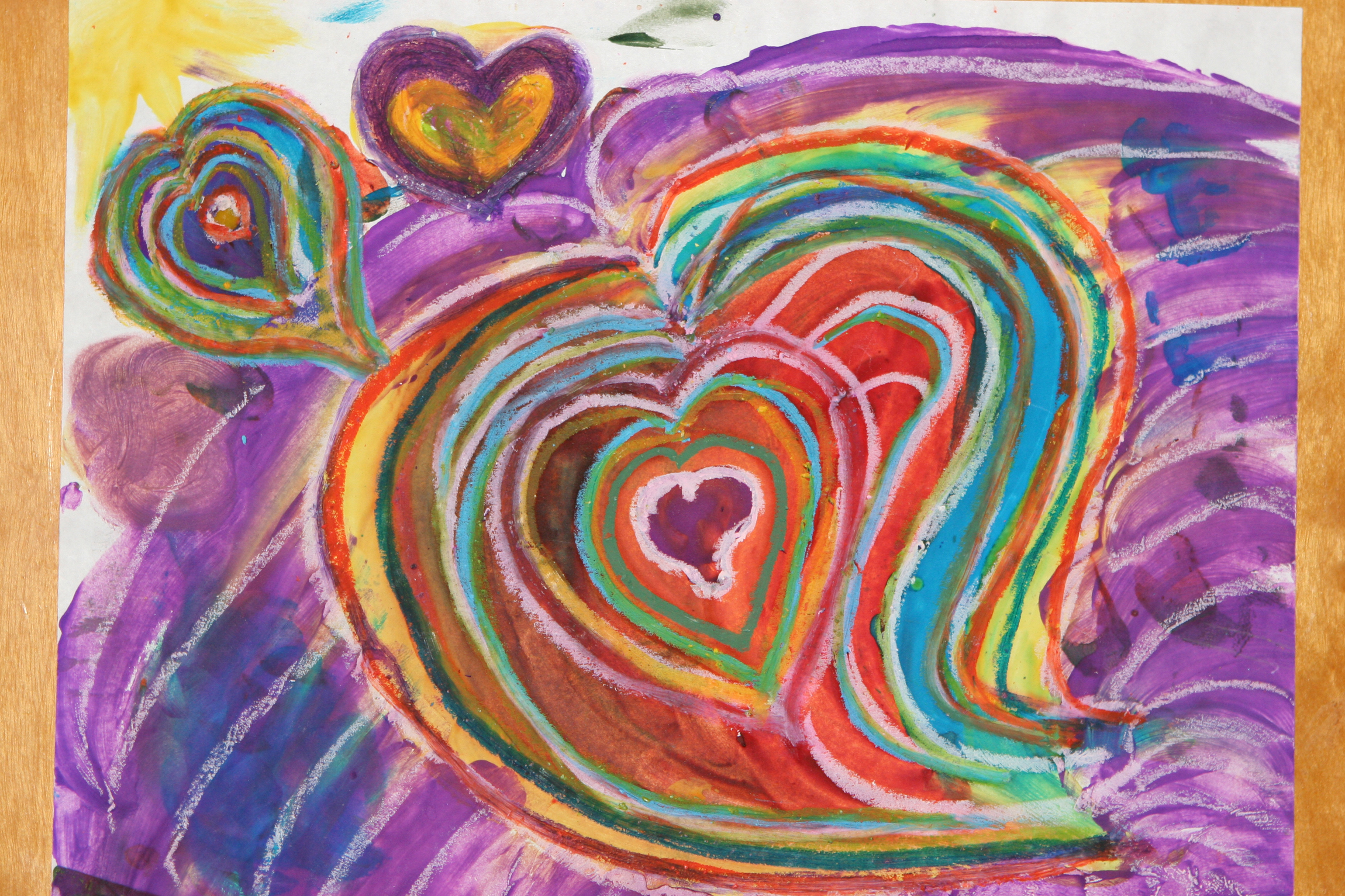
copyright Lucy Jeanette LaFaive

Creative Inspiration: Healing Hearts

by Lucy Jeanette La Faive

Five years ago, in March 2003, on the eve of the war in Iraq, I was very terrified that the United States Government was choosing to go to war. I was feeling helpless and fearful about what the outcome might be, fearing violence, destruction, and the death of many people. So one night I decided to finger paint my feelings. I feel very connected to my emotions when I use my fingers directly in the paint. I can literally feel my emotions move through my fingers onto the paper.

I started with dark colors – black and brown – then I just began dumping other colors on the paper and moving my fear, frustration, anger and helplessness through my fingers. Suddenly I realized the page was green. Green is the color of the heart chakra (energy center), also known as the bridge between mind and body. It is the color of healing.

The realization transformed me. I started to move my fingers in the shape of a heart. What resulted was a green heart. I later highlighted the heart shapes already in the painting with white oil pastel.

This painting transformed my feelings and me. It symbolizes that fear can be transformed into love. I painted two other paintings the same night. The second is mostly red, with hearts layered one on top of the other. The third painting is multicolored, with one large heart and two smaller hearts. I highlighted the colors and shapes already in the painting with oil pastels.

I titled the paintings “Healing Hearts: Transforming FEAR into LOVE,” because these paintings healed my heart by transforming my fear into love. I still had no control about whether the U.S. went to war, but I no longer was struggling with my emotions and a decision over which I had no control.

I could have spent the past five years living in fear, anger and frustration about a war that continues or I can live with love and joy. I choose to live with my heart open with love.

I feel love and joy when I see these paintings rather than the death and destruction I was stressing about at the time I started them. The love came through the struggle, the struggle I was having with my emotions.

I know that if art can be this meaningful to me, it can be healing, transforming and powerful for you too. So next time you are wrestling with something, give art a try.  Maybe it will transform you too!

Lucy Jeanette La Faive, certified wellness speaker, uses art for healing and self-discovery.  Lucy does coaching, workshops, and presentations on joyful living, self-love, self-discovery, creativity, self-care, healing, body image, personal empowerment, movement, and stress management. Free consultations. Contact Lucy at 906-225-1059 or lucyis@chartermi.net.


Reprinted with permission from the Summer 2008 issue of Health & Happiness U.P. Magazine, copyright 2008. All rights reserved.

Older Than the Hills + 10th Anniversary Celebration

In celebration of our 10th Anniversary, Health & Happiness is posting some of its best articles from its first 10 years throughout the month of September.

If you like what you read here, please LIKE and SHARE this post, FOLLOW our site, and JOIN us on our Facebook page.

And if you’re in the Marquette area on Sept. 30th, please join us in celebrating our anniversary at YOUR Health & Happiness Forum from 1 pm – 4 pm in the Community Room of the Peter White Public Library.

Stay posted for more details! And please enjoy the second article in our September Retrospective series!

Gifts from Nature: Older Than the Hills

by Robert Regis

Having grown up in the U.P., I was intrigued by the rocks and minerals and the spectacular rock outcroppings seen in my nearby travels. One such place is Pictured Rocks National Lakeshore. There you see rusty red and orange sandstone rising abruptly from the deep blue waters of Lake Superior, making a dramatic visual contrast. Beautiful indeed, but the young scientist in me asked where did those sandstones come from? And what makes them so red? Why are the cliffs so dramatic?

Turns out the sandstones are quite young, compared to other rocks around the U.P. They are a mere 500 million years old! They were deposited along an ancient shoreline, with streams depositing sand across a gentle, rocky plain. Except at that time, the PRNL was located just south of the equator. That’s right, the equator. There were no palm trees lining the beach, though, for land plants had not yet made their appearance on Earth. It was a barren scene.

The rocks tell a story of change over time, like pages in a book. At the base of the cliffs, right at or below water level, is the Jacobsville Sandstone, named for sandstone quarry owner John Henry Jacobs. There, the rock was quarried for building stone, and may be seen in many buildings around the U.P. (Marquette Courthouse and the Cathedral, etc). Above the Jacobsville Sandstone is the Munising Formation, which forms most of the vertical cliffs. The lower member is the Chapel Rock Sandstone, and above it is the Miners Castle Sandstone. Although similar, the sediments that make up the Chapel Rock Sandstone came from a different source than the Miners Castle, and hence have a slightly different appearance. The structures and minerals in the rocks show the sediments first came from highlands to the south (Chapel Rock) and later from the east (Miners Castle) as seas encroached on the land and became deeper and deeper. The red color comes from hematite, which stains the sediments. Above the sandstone cliff is a bed of dolomitic sandstone, which indicates that the deepening ocean was warm but still shallow. Dolomite forms a resistant layer that is difficult to erode, and is the “caprock” that protects the layers below. It is responsible for the many waterfalls and abrupt topography in PRNL because streams have difficulty eroding through the layer.

Moving west toward Marquette, you can see the Jacobsville Sandstone again at Presque Isle Park. In some places, the sandstone has lost its red hematite coloration by chemical leaching and is now white.

The name Presque Isle means “almost an island.” In fact, not too many years ago (to a geologist) the park was an island. You can observe the old shorelines of glacial Lake Nipissing (pre-Lake Superior) from about 5,000 years ago at the bandshell and the gazebo near the entrance to the park. The bluffs were formed by waves eroding into the island when the lake was about twenty-five feet higher. An underwater ridge of sand developed between the island and the mainland, and when the lake lowered, the ridge became a land connection which geologists call a “tombolo.” The road to the Park is on the tombolo.

Underneath the sandstone is rock that locals refer to as “Black Rocks.” The Black Rocks are a metamorphosed igneous peridotite about 1.7 billion years old! The rock was exposed previously, because the Jacobsville Sandstone rests directly on top of that ancient erosional surface (called a nonconformity). You can see this nonconformity at many places in the Park, but probably best along the west side, south of “Sunset Point.”

Robert Regis has been a geology Professor at Northern Michigan University for over twenty years. His degrees are from NMU, Indiana State University, and Michigan Tech University. He has published and presented numerous articles on the geology of the U.P.

Reprinted with permission from the Summer 2012 issue of Health & Happiness U.P. Magazine, copyright 2012, all right reserved.